Skip to content
News & Events

document-m
News
Stay up to date with the latest company updates, industry insights, and technology trends.
edi-m
Blog & Knowledge hub
Gain expert perspectives and practical knowledge through articles, case studies, and industry analyses.
AI AGENTS

Automate conversations, decisions, and workflows with human-like AI precision.

Nearshore vs Offshore

5 Reasons to Consider Nearshore vs Offshore for your business needs

Jan 28, 2026

Summary: Nearshore and offshore outsourcing are two ways to get services from other countries. Nearshore partners are in countries that are close and have similar time zones. Offshore providers are farther away and have bigger time differences.

Both can lower costs and increase access to skills. However, they come with different trade-offs in teamwork, risk, and effort in managing. Many growing businesses now evaluate nearshore vs offshore software development not only on rates but on how each model supports product speed, innovation, and customer experience. The five reasons below highlight where nearshore often has an edge—and where offshore still makes sense.

Reason 1: Cost Efficiency

Cost is usually the first lens in the nearshore vs offshore IT outsourcing conversation. Offshore companies in places with lower wages usually have the lowest hourly rates. Nearshore teams have costs that are between onshore and offshore teams.

Understanding Cost Structures

Total cost is more than hourly rates; it includes coordination time, rework, travel, ramp‑up, and management overhead. Offshore models can lead to significant headline savings but might bring hidden expenses due to time zone differences, communication issues, or slower decision-making processes.

Nearshore outsourcing often has higher hourly rates than offshore options. However, it can reduce costs related to misunderstandings, delays, and quality problems. This is because it allows for better teamwork and management. When you think about how long a project may take and the chance it could fail, working with teams close by can often save money for complicated or important projects.

Nearshore vs Offshore: A Financial Breakdown

The table below summarizes typical cost‑related aspects of nearshore vs offshore outsourcing.
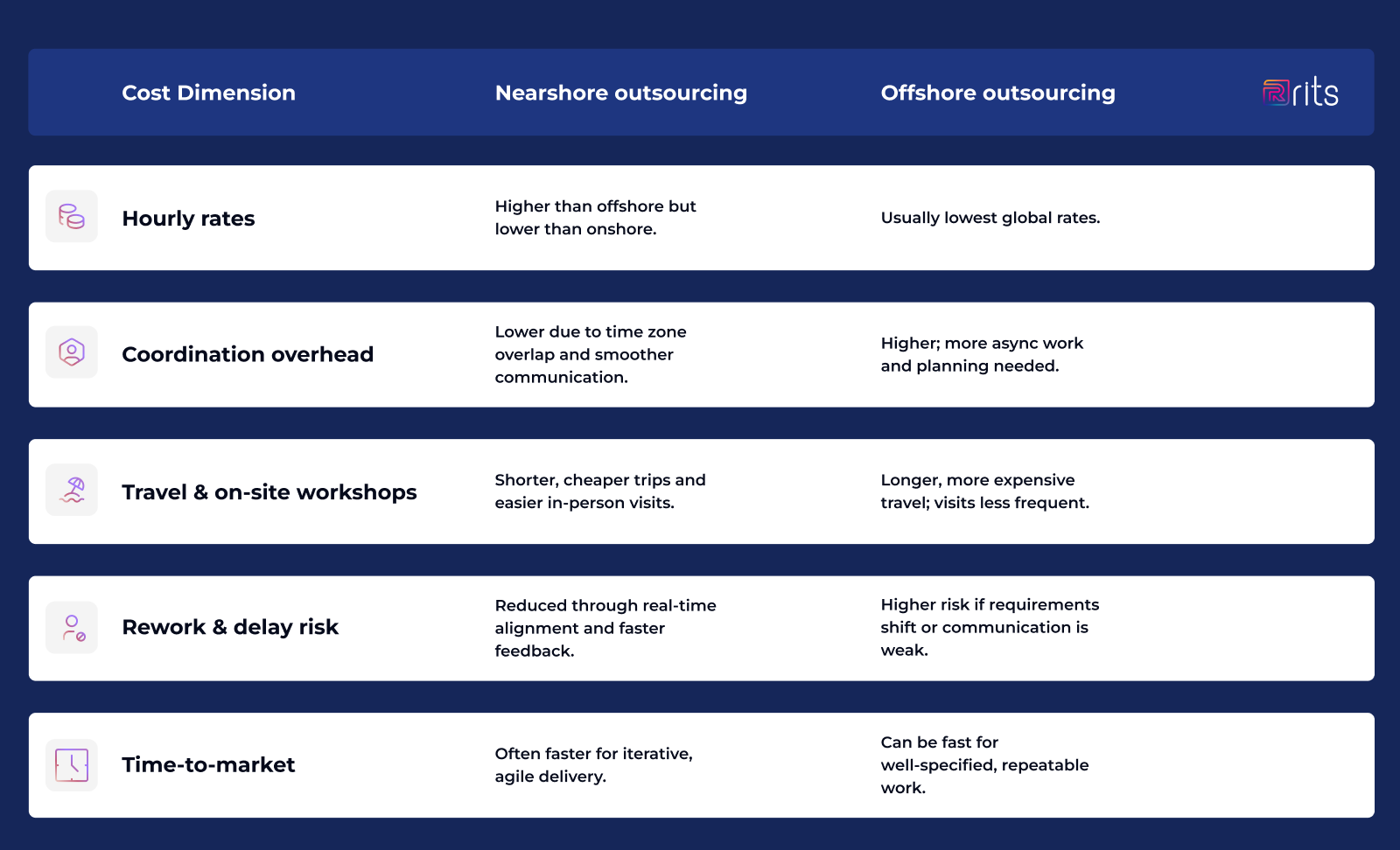
Nearshore vs Offshore

If your main aim is to maximize short-term savings on specific tasks, choosing offshore services remains the best option. However, if you're looking to balance cost savings with speed, reliability, and strategic benefits, nearshore services often provide more value across the entire project lifecycle.

Reason 2: Communication and Collaboration

Communication quality is one of the most important—and underestimated—differences in nearshore vs offshore development effectiveness. Collaboration friction can quickly erode apparent cost advantages.

Language Barriers and Cultural Similarities

Nearshore partners generally share more cultural affinity, similar business practices, and stronger language alignment with client markets. This reduces misunderstandings in requirements, clarifications, and feedback, especially in customer‑facing or innovation‑driven work.

Offshore teams may still provide excellent communication, but differences in language nuance, hierarchy, and decision‑making style can slow down discussions or bury dissent. Organizations that do not invest in cross‑cultural training or explicit communication norms feel these gaps more strongly.

Time Zone Advantages in Nearshore vs Offshore

Time zone alignment is where nearshore vs offshore outsourcing diverges most clearly. Nearshore teams often work within a 1–4 hour difference, which supports real‑time stand‑ups, workshops, and ad‑hoc problem solving.

Offshore teams usually operate with substantial time gaps, requiring more structured schedules, handoffs, and asynchronous documentation. This can be an advantage for follow‑the‑sun support or 24/7 operations, but it complicates daily collaboration on evolving product requirements.

For agile organizations, these differences make nearshore vs offshore software development a question of how quickly you need feedback and decisions. If rapid iteration and shared ceremonies are critical, nearshore typically produces smoother collaboration and fewer surprises.

Reason 3: Access to Talent

Both models expand access to global talent, but they do so with different characteristics in depth, specialization, and availability. Evaluating offshoring vs nearshoring means understanding not just how many people are available, but how they fit your use case.

Talent Pools: Comparative Analysis

Offshore locations, especially in Asia and parts of Eastern Europe, provide a huge number of engineers, BPO agents, and technology specialists. This scale enables rapid team expansion, high‑volume operations, and around‑the‑clock coverage when needed.

Nearshore regions typically provide smaller but still substantial pools focused on specific client markets, such as Latin America for North America or Eastern Europe for Western Europe. These ecosystems often emphasize modern stacks, product engineering, and domain expertise tailored to nearby economies.

Offshoring vs Nearshoring: The Tech Talent Debate

From a pure numbers perspective, offshore often wins in the tech talent debate because of population size and mature outsourcing industries. For commodity skills or standardized processes, this can be ideal.

However, when high‑engagement collaboration, domain understanding, and co‑creation matter, nearshore software development talent can be more effective per person‑hour. Nearshore teams tend to integrate faster with client product squads, share similar work rhythms, and adapt more easily to changing priorities.

The most sophisticated organizations sometimes combine both: using offshore for scale and cost‑sensitive workloads, and nearshore for higher‑touch engineering, product, or client‑facing functions. This hybrid offshore vs nearshore vs offshore outsourcing approach maximizes talent options while controlling collaboration risk.

Reason 4: Flexibility and Scalability

Outsourcing is often chosen to increase organizational flexibility and scale capacity up or down without the overhead of permanent hiring. How flexibly each model supports these goals is a key part of the nearshore vs offshore pros and cons analysis.

Adapting to Business Needs

Both nearshore and offshore vendors typically offer flexible engagement models—dedicated teams, staff augmentation, managed services, or project‑based work. Offshore providers often excel at building very large teams quickly, making them attractive for high‑volume or transactional operations.

Nearshore partners, because of closer alignment and easier interaction, tend to adapt more smoothly when strategies, roadmaps, or priorities change. For growing businesses whose product direction is still evolving, this adaptability reduces the risk of being locked into rigid delivery patterns.

Nearshore vs Offshore Development Effectiveness

Development effectiveness is not just about throughput; it is about how efficiently a team converts effort into working, valuable software. Nearshore development effectiveness benefits from faster feedback loops, shorter learning curves, and easier “course corrections” mid‑sprint.

Offshore development effectiveness is highest when tasks are well‑documented, requirements are stable, and long planning horizons are acceptable. In such contexts, the combination of low rates and large teams can deliver high volumes of output efficiently.

Organizations that frequently pivot, experiment, or reprioritize features often find that nearshore vs offshore development feels less brittle and more responsive to change. Those with steady, repeatable workstreams can safely lean more heavily on offshore capacity.

Reason 5: Quality Control

Quality control is where differences in distance, communication, and culture become visible in outcomes. The model you choose shapes how easily you can maintain standards and correct issues before they become expensive.

Managing Quality Assurance Across Borders

Both nearshore and offshore partners can implement robust QA processes, test automation, and compliance frameworks. The question is how easily your organization can oversee, align, and collaborate on these practices.

Nearshore teams, thanks to overlapping hours and geographic proximity, support more frequent reviews, joint retrospectives, and live troubleshooting. This enables faster detection of defects, better shared understanding of “quality,” and more responsive remediation.

Offshore quality management usually requires more structured governance: clear SLAs, well‑defined acceptance criteria, and scheduled checkpoints. When organizations invest in these structures, offshore teams can deliver high quality, but the ramp‑up and oversight overhead are higher.

Nearshore vs Offshore Pros and Cons

The table below summarizes major nearshore vs offshore pros and cons across key decision dimensions.

Nearshore vs Offshore

For many growing companies, nearshore vs offshore IT outsourcing is not a binary choice; different models can be used for different layers of the tech and operations stack. The most important step is aligning the model with the type of work and the level of collaboration required.

Conclusion and key takeaways

Choosing between nearshore vs offshore outsourcing starts with clarifying your priorities: deepest cost cuts, or a balanced mix of savings, collaboration, and quality. Offshore excels when your main goals are budget, scale, and standardized processes; nearshore shines when speed, alignment, and long‑term strategic impact matter most.

Many organizations ultimately adopt a hybrid nearshore vs offshore strategy, using each model where it is strongest and orchestrating them as part of an integrated global delivery approach. By assessing cost structures, communication needs, talent requirements, flexibility, and quality control, your business can choose the outsourcing mix that best supports its roadmap and growth goals.

Go to

Lates Articles