

Data & AI
We turn complex data into clear insights, helping leaders make smarter decisions and drive growth.
Discover how Data & AI are transforming strategies into measurable growth.
Redefine customer management with self-optimizing, intelligent CRM ecosystems.
Build meaningful relationships through data-powered loyalty and real-time personalisation.
Automate conversations, decisions, and workflows with human-like AI precision.
Large organizations have fundamentally changed how they manage knowledge, automate processes, and empower employees. Enterprise AI assistants have evolved from experimental pilots to essential infrastructure, with adoption accelerating across industries such as financial services, healthcare, manufacturing, and professional services. Understanding how these systems operate, where they add the most value, and how to assess them is now a key competency for technology and business leaders.
Enterprise AI assistants differ from consumer-facing chatbots. They are designed to handle sensitive data, integrate with enterprise software, meet compliance requirements, and scale to thousands of users. The global enterprise AI market is expected to exceed $200 billion by 2030, with AI assistants among the fastest-growing segments.
This guide explains the foundational concepts of enterprise AI assistants, compares leading approaches, explores proven use cases, and offers a framework for evaluating platforms based on your organization's needs. Whether you are researching software, comparing solutions, or building a business case for AI-powered knowledge management, this resource provides essential guidance.
Key insight: Organizations that implement enterprise AI assistants with a defined knowledge management strategy report a 30-40% reduction in employee time spent searching for information, according to multiple industry analyses from 2025 and 2026.
Most enterprise AI assistants integrate a large language model (LLM) with retrieval-augmented generation (RAG). The LLM manages reasoning and language generation, while RAG connects the model to your organization’s knowledge base in real time. This integration sets enterprise AI assistants apart from general-purpose consumer tools.
RAG stores internal documents, policies, databases, and communications in a vector database. When a user submits a query, the system retrieves relevant content and supplies it to the LLM as context, grounding responses in organizational data rather than relying solely on pre-trained knowledge. This method reduces hallucinations and delivers accurate, up-to-date responses without frequent or costly retraining.
When evaluating enterprise AI assistant platforms, assess the quality of the RAG pipeline as thoroughly as the underlying model. The retrieval mechanism determines whether the assistant provides answers based on your specific policies and data or defaults to generic responses without organizational context.
A key advancement in enterprise AI assistants is the move from conversational interfaces to agentic systems that autonomously execute multi-step tasks. An agentic assistant can draft emails, update CRM records, schedule meetings, trigger approval workflows, query databases, and summarize findings within a single conversation.
This capability depends on tool use, in which the model accesses a defined set of APIs and determines which tools to use and what to use them for, based on user intent. Leading platforms such as Microsoft Copilot, Salesforce Einstein, ServiceNow AI, and other enterprise AI assistant vendors now offer varying levels of agentic functionality. Key evaluation criteria include reliability, auditability of actions, and the range of native integrations available.
For organizations handling regulated data, the security architecture of an enterprise AI assistant is as important as its functionality. Key areas to evaluate include data isolation, role-based access control, and data residency. Data isolation prevents your data from being used to train shared models or accessed by other tenants. Role-based access control ensures the assistant provides information only to authorized users. Data residency ensures data processing remains within required geographic boundaries.
Compliance-ready enterprise AI platforms typically offer SOC 2 Type II certification, GDPR and HIPAA compliance options, audit logging for all queries and actions, and private deployment options either on-premises or within a dedicated cloud environment. Organizations in financial services should also verify alignment with frameworks such as SR 11-7 for model risk management, while healthcare organizations should validate Business Associate Agreement coverage for any PHI processing.
Organizations often evaluate enterprise AI assistants after implementing rule-based chatbots, robotic process automation (RPA), or basic search tools. Comparing these solutions by capability, cost, and scalability is critical for informed architectural decisions.
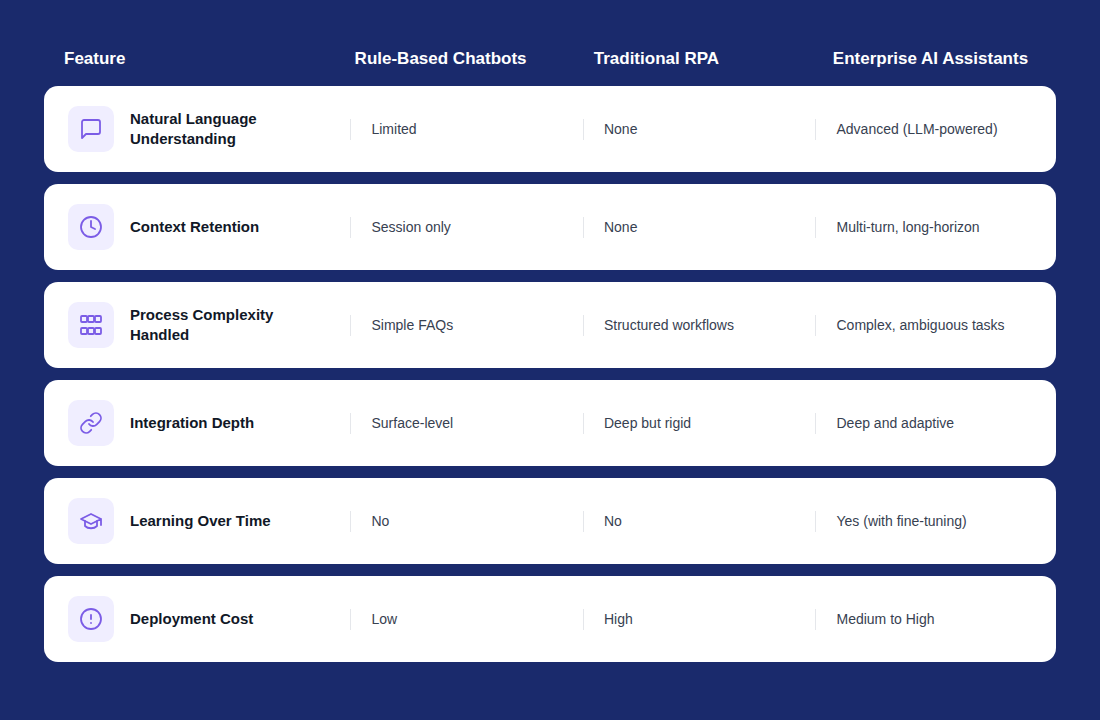
This comparison indicates that enterprise AI assistants function best as a successor layer to chatbots and RPA, rather than replacing any single tool. Successful deployments use AI assistants to orchestrate existing RPA workflows, deciding when to trigger automation, escalate to a human, or resolve requests through conversation.
When evaluating enterprise AI assistant vendors, prioritize the integration ecosystem. Platforms with robust native connectors to existing ERP, ITSM, HRIS, and CRM systems deliver value more quickly than technically superior models with limited integration. Most deployment costs are driven by integration and change management, not the AI platform license.
Enterprise AI assistants deliver high ROI in IT service desks. They can autonomously resolve 40 to 60 percent of Tier 1 IT tickets, handling password resets, software provisioning, VPN troubleshooting, and onboarding. The assistant integrates with ITSM platforms to manage tickets and escalates to human agents with full context when needed.
Large financial institutions and global manufacturers report saving millions annually through IT self-service automation, while also achieving 24/7 availability across time zones without increasing staff.
Enterprise knowledge is often fragmented across platforms like SharePoint, Confluence, shared drives, Slack, email, and specialized databases. AI assistants with strong RAG implementations provide synthesized answers rather than just lists of links, regardless of where information resides.
This use case is especially valuable for organizations with complex products, regulatory requirements, or changing policies. Sales representatives can access current competitor information, compliance officers can query policy documents across jurisdictions, and new employees receive immediate onboarding support without relying on senior staff.
Enterprise AI assistants also serve as customer-facing agents for support, product guidance, and sales qualification. These deployments require brand alignment, tone consistency, and fallback strategies to maintain quality at scale. Leading solutions combine LLM-based conversation with integration into order management, ticketing, and CRM systems, enabling the assistant to take action rather than only provide information.
Organizations in regulated industries such as insurance, banking, and healthcare must implement explainability mechanisms for customer-facing AI assistants. These mechanisms ensure the system can provide rationales for recommendations or actions, supporting compliance and building customer trust.
Departments with high volumes of internal information requests are strong candidates for enterprise AI assistants. HR teams use assistants to answer policy questions, guide benefits enrollment, and support performance reviews. Legal teams rely on assistants for contract clause lookup, compliance queries, and initial document review. Finance teams automate variance explanations, month-end close queries, and on-demand budget reporting.
When building a business case for these use cases, structure your evaluation around the following primary criteria:
Evaluating enterprise AI assistants requires examining real-world deployments rather than relying only on vendor benchmarks. UNIQA, one of Poland's largest insurers, implemented an AI Knowledge Assistant that demonstrates how these concepts deliver measurable business results.
Before implementation, UNIQA faced operational challenges typical of large, regulated enterprises. Agents and consultants managed a vast, frequently updated library of General Insurance Conditions (GIC/OWU documents), product tariffs, and internal procedures. The sheer volume of documentation made fast, reliable access nearly impossible using conventional search methods.
Four key pain points increased operational costs and reduced service quality. First, the document library's low searchability made it difficult for agents to quickly locate the correct clause or policy provision. Second, average handle time (AHT) was high because consultants spent significant time manually searching for answers. Third, inconsistent responses emerged across channels, with the call center, email team, and chatbot sometimes providing different answers to the same customer questions. Fourth, onboarding new agents was lengthy and costly due to the lack of an efficient way to train them on a complex product portfolio.
RITS implemented an intelligent assistant panel integrated into the agent's existing interface, built on a RAG architecture using PLLuM, a foundation model optimized for Polish. This deliberate choice addressed the accuracy loss seen with generic multilingual models, ensuring the precision required in regulated industries.
The system architecture addressed all four challenges. The AI suggestions panel provides verified, ready-to-use answers during live customer interactions, eliminating manual document searches and reducing AHT. Automated summarization converts complex legal provisions from OWU documents into clear, customer-facing language, reducing handling time and the risk of misinterpretation. Integration with existing CRM and call center platforms created a single source of truth, ensuring consistent answers across all channels.
For security, the solution was deployed on-premise rather than in a public cloud, meeting the requirements for handling sensitive policy and customer data. The RAG architecture was configured for strict hallucination control, ensuring every response is grounded in retrieved documentation rather than model-generated assumptions.
The project used a phased rollout to manage risk and validate results before full deployment. The first two weeks focused on process audit and discovery, mapping workflows, and identifying high-impact starting points. Weeks three to six covered data integration, knowledge base preparation, and RAG infrastructure configuration. Weeks seven and eight involved model calibration and a controlled pilot with selected agents. Full-scale deployment and KPI optimization began after week eight.
This structured approach reflects best practice: start focused, validate with real users, and then scale. The phased methodology also reduced change management friction by addressing adoption concerns incrementally instead of introducing the new system to the entire agent network at once.
The UNIQA deployment demonstrates key principles for enterprise AI assistant implementations in regulated industries. A purpose-built Polish language model ensured the accuracy required by customers and regulators. A strict RAG configuration addressed hallucination risks, which often deter enterprises from using AI in sensitive workflows. On-premise deployment simplified security compliance and removed a common procurement barrier.
UNIQA representative statement: The implementation of the Intelligent Knowledge Assistant is a strategic step toward modern customer service. The organization has gained a tool that supports employees in real-time with precise and verified knowledge. This is not just a technological innovation, but above all, a tangible improvement in insurance standards, where the accuracy of information builds customer trust.
For organizations in insurance, banking, healthcare, or other regulated sectors, the UNIQA case study demonstrates that domain-specific language models, strict RAG grounding, secure deployment, and deep integration deliver results that generic AI tools cannot achieve.
Enterprise AI assistants are among the most significant technology decisions organizations will face in the next five years. Organizations that deploy them strategically are already seeing greater productivity, improved employee experience, and higher operational efficiency compared to those using them as isolated solutions.
Organizations with the best results treat the AI assistant as an intelligent coordination layer across their knowledge and workflow infrastructure, not as a standalone tool. They invest in the quality of their knowledge assets as well as the platform, understanding that the assistant’s effectiveness depends on the information it accesses. They also establish governance frameworks to ensure accuracy, compliance, and ongoing improvement, viewing deployment as an ongoing process rather than a one-time project.
Whether you are researching AI assistant options, refining your deployment, or scaling a pilot, clarity of purpose is the most important investment. Define the problems you are solving, the stakeholders involved, and your success metrics. With this foundation, enterprise AI assistants can deliver increasing returns as both systems and organizational knowledge mature.


