

Data & AI
We turn complex data into clear insights, helping leaders make smarter decisions and drive growth.
Discover how Data & AI are transforming strategies into measurable growth.
Redefine customer management with self-optimizing, intelligent CRM ecosystems.
Build meaningful relationships through data-powered loyalty and real-time personalisation.
Automate conversations, decisions, and workflows with human-like AI precision.

Customer retention is a critical competitive advantage in today’s business landscape. For large organizations managing millions of customer relationships across various channels, an enterprise loyalty program is essential. It delivers the infrastructure needed to drive revenue, strengthen brand affinity, and generate first-party data for sustained growth.
This guide offers decision-makers, program managers, and technology teams essential insights for designing, launching, and optimizing enterprise-scale loyalty programs. Whether you are evaluating loyalty software for the first time or updating an existing system, you will find actionable frameworks and practical guidance here.
With third-party cookies being phased out and digital advertising costs rising, customer acquisition is now 5 to 7 times more expensive than retention, according to industry research. In this context, a well-designed enterprise loyalty solution serves as a direct revenue driver rather than a peripheral initiative.
For enterprises in retail, financial services, hospitality, airlines, or B2B sectors, loyalty programs fulfill several business objectives. They capture unique behavioral data, reduce churn among high-value customers, increase average order value through tiered incentives, and create switching costs that help protect market share.
The move toward omnichannel loyalty programs has increased urgency. Customers now expect seamless recognition across mobile apps, in-store terminals, call centers, and e-commerce platforms. Meeting these expectations requires enterprise-grade architecture rather than pieced-together solutions.
Loyalty programs vary significantly in scale and complexity. A small business using a digital punch card faces different challenges than a global retailer managing a 50-million-member program across 30 markets. Enterprise-grade loyalty platforms stand out due to several key characteristics.
First, enterprise platforms are designed to handle high transaction volumes without compromising real-time point accrual, redemption, or fraud detection. Supporting millions of daily transactions with sub-second response times requires robust architecture beyond the capabilities of smaller platforms.
Second, enterprise loyalty software integrates deeply with existing technology stacks, including CRM systems, ERP platforms, POS infrastructure, CDP tools, and marketing automation suites. The extent of integration often determines vendor selection.
Third, enterprise programs support multi-brand, multi-currency, and multi-language deployments. For example, a hospitality group with diverse properties requires a unified loyalty platform that delivers tailored experiences for each brand while maintaining a single member profile.
Enterprise loyalty program structures have evolved significantly in the past decade. Understanding these mechanics enables organizations to design programs that align incentives with business objectives, rather than replicating competitors’ approaches.
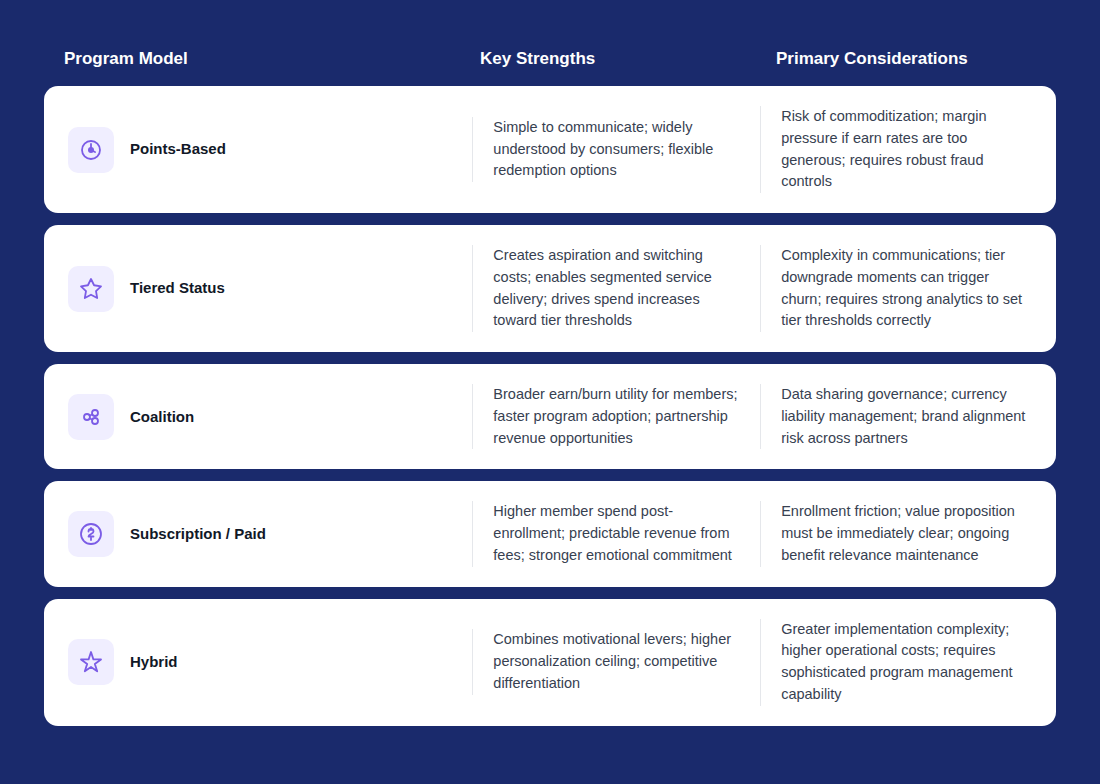
Points-based loyalty systems are the most common model. Members earn points for qualifying purchases or behaviors and redeem them for rewards, discounts, or experiences. While these systems offer simplicity and flexibility, they risk commoditization when widely adopted by competitors.
Tiered loyalty programs introduce status levels, such as Silver, Gold, or Platinum, that provide increasing benefits. Tiers encourage aspiration and make it less likely for members to leave after investing effort to reach higher levels. This model, pioneered by airlines and hotels, is now common in retail, financial services, and subscription businesses.
Coalition loyalty programs enable multiple brands to share a single rewards currency, expanding earning and redemption options for members. While this model can accelerate adoption, it also creates governance challenges related to data sharing, liability for outstanding points, and brand alignment.
Subscription loyalty programs, also known as fee-based programs, require members to pay an annual or monthly fee for premium benefits. Amazon Prime is a leading example, though many brands have adopted similar models. According to McKinsey, paid loyalty members are 60 percent more likely to increase their spending with the brand after joining compared to free program members.
Analyzing how leading organizations structure their loyalty investments uncovers patterns that support more effective program design.
Starbucks Rewards is widely recognized as a benchmark for enterprise loyalty programs in consumer retail. In 2016, the program transitioned from a visit-based to a spend-based model, which increased revenue per transaction by encouraging higher-value purchases. By 2024, the program had approximately 33 million active U.S. members and accounted for over 57 percent of total U.S. company-operated sales. Its success is driven by strong mobile app integration, personalized offers powered by machine learning, and gamification features such as bonus star challenges that influence customer behavior.
Marriott Bonvoy demonstrates the complexity of consolidating enterprise loyalty programs after a merger. Following the 2016 Starwood acquisition, Marriott unified three separate programs into a single platform, serving 110 million members. This migration took about three years and required renegotiating hundreds of partnerships. Enterprises considering program redesigns or M&A-driven consolidations should recognize that loyalty infrastructure is deeply embedded and requires significant member communication and change management.
Sephora Beauty Insider shows how a tiered loyalty program can drive retention and advocacy in the beauty and personal care sector. The three-tier structure, with the highest tier requiring $1,000 in annual spend, sets a clear aspirational goal. Sephora leverages tier data to personalize email and app communications, resulting in higher open and conversion rates than non-segmented campaigns.
Several common beliefs about loyalty programs cause organizations to make design decisions that fall short of expectations.
Misconception 1: More rewards equal more loyalty. Increasing the generosity of a points program does not automatically strengthen loyalty. Research shows that emotional loyalty, driven by recognition, personalization, and perceived value alignment, is a stronger predictor of long-term retention than transactional incentives. Overly generous programs can also erode margins without changing customer behavior.
Misconception 2: Loyalty programs work the same way across all segments. High-frequency, lower-spend customers respond differently to program mechanics than low-frequency, high-spend customers. Enterprise loyalty analytics must segment the member base and apply different engagement strategies accordingly. A one-size-fits-all reward structure typically optimizes for neither group.
Misconception 3: Technology is the hard part. Technology selection is important, but enterprise loyalty program implementation failures most often stem from inadequate change management, misaligned internal stakeholders, or insufficient investment in member communication. The program strategy and operating model must be validated before committing significant technology spend.
This framework outlines how leading enterprises develop loyalty programs, from strategic alignment to ongoing optimization.
1. Define business objectives and success metrics. Determine if the primary goal is to reduce churn among high-value customers, increase average transaction value, accelerate new customer onboarding, or generate first-party behavioral data. Each objective requires distinct program mechanics and KPIs.
2. Conduct member segmentation analysis. Before designing program mechanics, analyze behavioral and attitudinal segments within your customer base. Identify segments that drive the most revenue, are at highest churn risk, or respond best to incentive-based marketing.
3. Select a loyalty platform architecture. Evaluate vendors based on real-time processing, API-first integration, native analytics and reporting, support for multi-brand and multi-market deployments, and total cost of ownership, including implementation and ongoing support.
4. Design program mechanics and the reward catalog. Structure earn rules, tier thresholds, and redemption options based on segment analysis. Assess financial liability for different earn rates before finalizing. Ensure the catalog includes both high-value rewards and accessible redemptions to engage all members.
5. Develop the member communication strategy. Create an enrollment journey, engagement calendar, and triggered communication framework. Personalization, enabled by program data, distinguishes high-performing enterprise programs from standard offerings.
6. Launch, measure, and iterate. Use a phased rollout to validate assumptions before full deployment. Set a governance schedule to review core metrics monthly and conduct strategic reviews quarterly. Integrate continuous improvement into the operating model from the start.
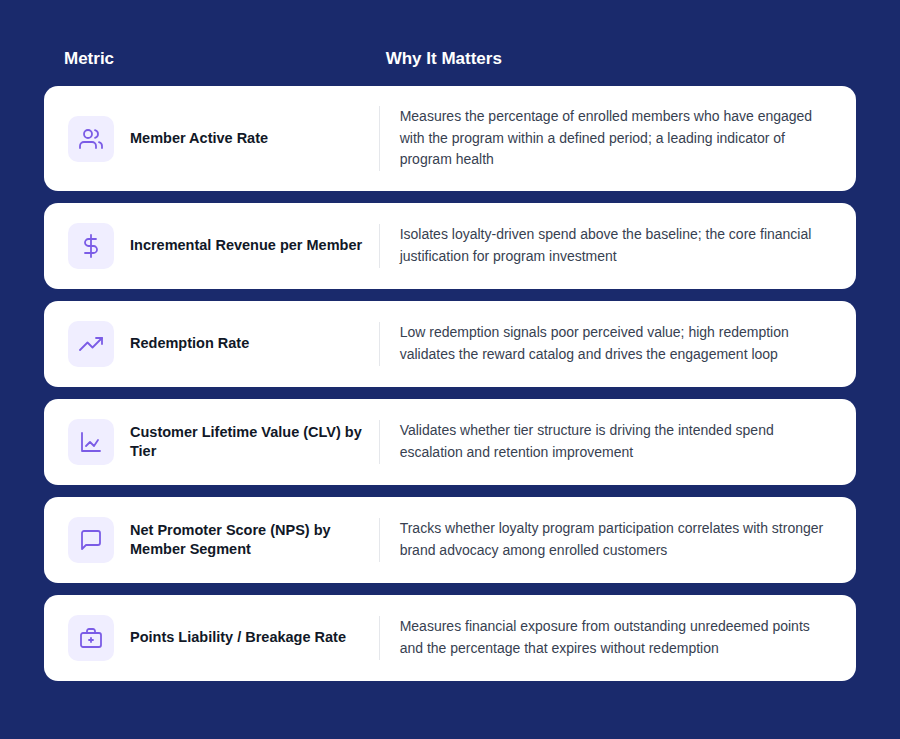
Tracking the right loyalty program ROI metrics is critical to demonstrating business value and making informed optimization decisions. The following are the metrics most tracked by enterprise loyalty teams.
The enterprise loyalty technology market has grown significantly, with purpose-built platforms, commerce cloud extensions, and custom solutions all competing for investment. When evaluating loyalty software vendors, look beyond feature lists to assess architectural suitability and the potential for strong long-term partnerships.
API-first architecture is essential for enterprises with complex technology environments. Platforms that on batch file transfers to sync member data with your CRM create operational bottlenecks and limit personalization. Real-time, event-driven integration supported by well-documented REST or GraphQL APIs should be the minimum requirement.
Carefully review scalability benchmarks during vendor evaluation. Request performance data for peak transaction loads that match your business needs. High-volume periods, such as Black Friday or major promotions, can overwhelm platforms not built for enterprise-scale concurrency.
Data residency and privacy compliance are now key evaluation criteria, especially for enterprises operating in the European Union, where GDPR significantly affects the processing of loyalty data. Platforms with flexible data residency options and built-in consent management frameworks help reduce compliance burdens.
The next generation of enterprise loyalty programs is driven by AI-powered personalization, expanded loyalty currencies beyond points, and the understanding that transactional mechanics alone do not build lasting customer relationships.
AI-powered loyalty personalization enables programs to move beyond static tier benefits and generic reward catalogs toward real-time, individualized offers generated based on predicted member behavior. Predictive models can identify the optimal moment, channel, and incentive to re-engage a lapsing member, or to recognize a member approaching a tier threshold with a targeted bonus challenge.
Experiential rewards have become more important as point-based programs become less differentiated. Access to exclusive events, early product launches, behind-the-scenes experiences, or priority service channels creates emotional connections that transactional rewards cannot match. These experiences also encourage organic social sharing, expanding the program's marketing reach.
B2B loyalty programs and channel partner solutions are attracting increased investment as enterprises recognize that engaging distributors, dealers, and partners follows similar psychological principles to consumer loyalty, but with a higher average lifetime value per participant.
Enterprise loyalty programs are among the most effective investments for organizations seeking sustainable revenue growth. When built on clear objectives, member segmentation data, scalable technology, and disciplined measurement, they deliver long-term returns through higher retention, increased share of wallet, and enhanced first-party data.
Organizations that gain the most from loyalty treat it as a strategic capability, not just a promotional tool. This requires investing in program management expertise, choosing technology partners who can scale with the business, and fostering a culture of continuous improvement for the member experience.
As you assess your current loyalty program or consider a new initiative, use this guide’s framework as a starting point. Program mechanics, technology choices, and reward design will differ by industry, customer segment, and competition. However, the core principle remains: customers who feel recognized, valued, and genuinely rewarded stay longer, spend more, and advocate more actively.
To build or optimize your enterprise loyalty program, first align internal stakeholders on a shared definition of success. Then, conduct a thorough audit of your customer data and technology infrastructure. The gap between your current state and a best-in-class program can almost always be bridged with the right strategy, platform, and organizational commitment.


