

Data & AI
We turn complex data into clear insights, helping leaders make smarter decisions and drive growth.
Discover how Data & AI are transforming strategies into measurable growth.
Redefine customer management with self-optimizing, intelligent CRM ecosystems.
Build meaningful relationships through data-powered loyalty and real-time personalisation.
Automate conversations, decisions, and workflows with human-like AI precision.

IT outsourcing services are now among the most strategic decisions for technology organizations. Companies use outsourcing to reduce costs, scale engineering capacity, and access specialized expertise that may be difficult to find internally. As a result, outsourcing IT functions to external vendors, contractors, and dedicated teams has become a primary growth strategy for many businesses worldwide (source - IT Services Outsourcing Market Size And Share Report, 2030).
However, a significant challenge remains. Organizations often lack reliable, objective data on the productivity of their external IT resources, despite substantial investments. While timesheets, story points, and Jira boards are updated, these metrics do not show whether outsourcing budgets are delivering real value or if spending is lost to unproductive time, context switching, idle hours, or undisclosed parallel work.
This guide explains the fundamentals of IT outsourcing services, including key cooperation models, their benefits and risks, effective vendor evaluation and management, and how Workforce Intelligence technology helps organizations better control external IT spending.
IT outsourcing involves contracting technology-related work, roles, or functions to third-party providers instead of relying solely on permanent, in-house employees. This can range from hiring a single contractor to engaging entire development departments as managed services from external suppliers.
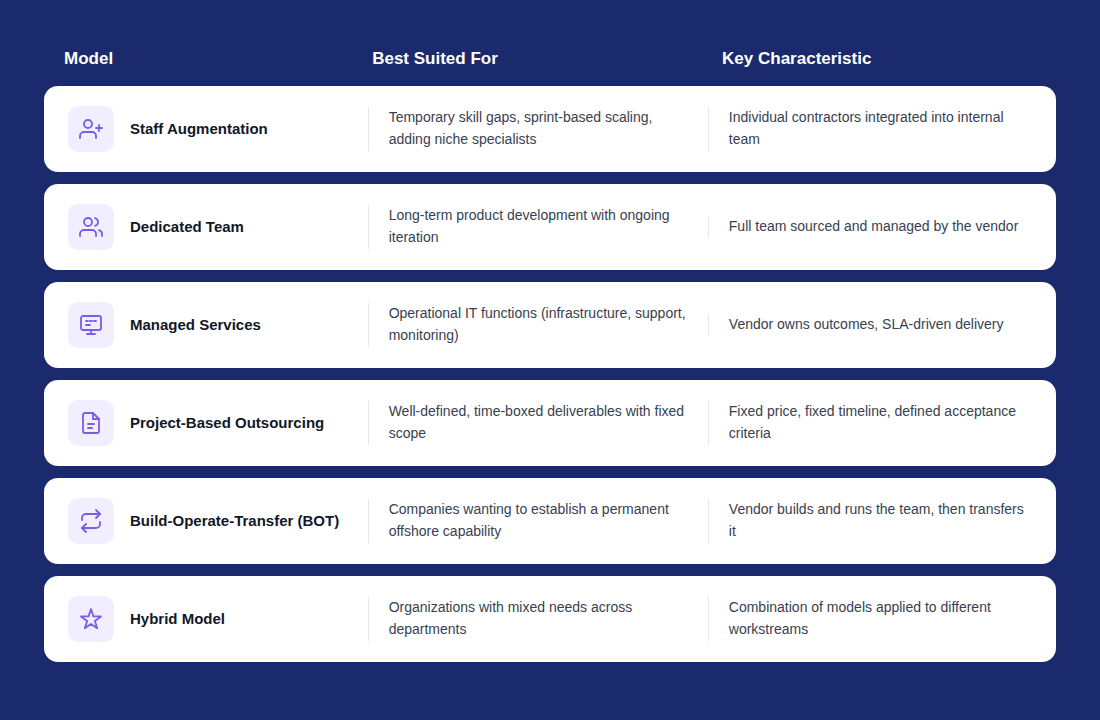
The most common cooperation models in IT outsourcing are designed to address various business needs, risk levels, and project types.
Effective IT outsourcing provides measurable value in cost, capability, and speed. Analyst research supports these benefits, and most IT leaders recognize them. Access to a global talent pool enables organizations to hire specialized engineers within weeks, compared to the longer timelines of internal recruitment. Variable cost structures allow companies to pay for capacity as needed and scale back when priorities change. Leveraging time-zone differences can also accelerate delivery cycles when managed proactively (source - 6 IT Outsourcing Trends Impacting 2026 and Beyond - Auxis).
In addition to these advantages, mature outsourcing programs enhance organizational focus. Internal engineering teams can concentrate on proprietary capabilities and competitive differentiation, while specialist vendors handle commodity IT functions, infrastructure management, and routine development work.
IT outsourcing risks often differ from those listed on risk registers. While security incidents, IP leakage, and compliance failures are widely addressed in enterprise contracts, productivity opacity remains underestimated. This refers to the challenge of verifying whether external IT resources are truly delivering productive work.
Industry benchmarks indicate that 20% to 30% of budgets for external IT resources do not result in productive, client-facing work. In most cases, this is not due to fraud. Instead, it stems from reduced visibility in remote work, time reporting based on self-declaration rather than actual activity, and management practices that do not scale to complex, multi-vendor outsourcing (source - Software Development Outsourcing Statistics 2026: Insights • SQ Magazine).
Organizations that achieve the greatest value from IT outsourcing follow disciplined practices. These are often overlooked in vendor sales discussions but consistently appear in reviews of successful outsourcing programs.
Most IT outsourcing procurement processes emphasize day rate comparisons. While important, this alone is not enough. Vendors with the same day rates can deliver very different costs per unit of productive work, depending on team efficiency. Rate benchmarking shows if you are paying a market price, while value benchmarking reveals if you are receiving market value. Value benchmarking requires data on actual working patterns, not just contractual terms.
Introducing workforce analytics mid-engagement often leads to resistance from vendors accustomed to limited transparency. By making data collection, activity monitoring, and productivity reporting contractual requirements from the start, organizations set clear expectations that budget allocation will be based on demonstrated value, not just declared availability.
Many organizations only benchmark vendors at contract renewal. High-performing programs make vendor comparison an ongoing process. Real-time data on supplier time allocation, delivery efficiency across technology domains, and productivity trends throughout the contract provide a factual basis for renegotiation, reallocation, and vendor development discussions.
External IT teams often spend considerable time on tasks that could be automated but are rarely reviewed for such opportunities. Activities like searching across disconnected knowledge bases, manually creating status reports, repetitive configuration, and excessive meetings are frequently identified as high-waste in workforce analytics. Addressing these can reduce costs and improve contractor experience.
Organizations with significant external IT spending often encounter a gap between invoiced costs and actual productive output. IT Workforce Intelligence from RITS provides IT and procurement leaders with the data needed to identify and pursue cost reduction opportunities.
The solution uses a lightweight, on-premise agent installed on contractor and vendor workstations. This agent passively records time spent in applications, pages, and tools without disrupting workflows. Data is consolidated in a central database, where AI analytics differentiate productive development work from meetings, production activity from idle time, and high-value contributions from repetitive tasks.
The solution provides management dashboards that update in near real time, giving IT leaders clear visibility into external resource utilization across vendors, teams, and individuals. Organizations can compare vendors based on actual work delivered per paid hour, rather than rates charged.
The solution is designed for rapid deployment, providing actionable data within about four weeks of installation. Most deployments achieve return on investment in under six months. All data remains on-premise and under client control, addressing common data sovereignty concerns in enterprise IT environments.
Key capabilities of IT Workforce Intelligence
Objectively measures working time across applications and tools. Identifies waste patterns such as excessive meetings, context switching, and information search overhead. Benchmarks vendor productivity based on actual work input rather than day rate. Provides continuous real-time dashboards, replacing monthly timesheet reviews. Identifies automation opportunities within outsourced workflows. Ensures data remains on-premise with full client control.
While every organization is unique, IT Workforce Intelligence deployments consistently uncover common patterns in outsourced IT budget usage. The most frequent findings are summarized below.
In multi-vendor environments, productivity varies significantly among suppliers charging the same day rate. The least efficient vendors often deliver 35 to 50 percent less productive work per paid day than the most efficient vendors on the same account.
Organizations without structured visibility into contractor work patterns typically identify recoverable budget equal to 10 to 15 percent of their total external IT spend within the first 90 days of a Workforce Intelligence deployment (source - IT Outsourcing Statistics 2025: Market Size, Trends & Insights).
Choosing the right external IT sourcing approach requires evaluating structure, risk, management overhead, and value. IT and procurement leaders usually focus on two main comparisons.
The decision between in-house hiring and outsourcing is rarely simple. Most organizations combine both, so it is important to find the right balance and establish an effective management strategy. In-house hiring provides more control over culture, institutional knowledge, and long-term capabilities. Permanent employees offer expertise and continuity that rotating external teams often cannot match.
IT outsourcing services offer greater flexibility and faster access to talent than in-house hiring. Filling specialized roles internally can take 4 to 6 months, while outsourcing to vendors can often be done in 2 to 3 weeks. For project-based needs, commodity functions, or niche specializations that do not require permanent staff, outsourcing typically delivers better value when total employment costs are considered.
Visibility is often overlooked. In-house teams are naturally visible, allowing managers to easily observe work patterns and engagement. Outsourced teams lack this by default. However, organizations can use workforce intelligence tools to restore visibility, closing most of the control gap while retaining the cost and flexibility benefits of outsourcing.
Hiring freelance contractors directly through platforms or networks is the simplest way to access external IT resources. This approach is best for short-term tasks, specialist projects, or when the internal team can manage an individual contributor. It offers cost advantages and usually enables faster engagement than vendor procurement.
However, scaling freelance contracting introduces risks that structured IT outsourcing is designed to address. Relying on a single freelancer creates concentration risk, as there is no backup or vendor accountability if issues arise. Moonlighting, where a contractor works for multiple clients at once, is also more likely without employer oversight. Structured outsourcing, especially with dedicated teams and managed service models, distributes these risks across a vendor with contractual obligations and replacement capacity.
Both models face productivity visibility challenges, but these are harder to resolve with freelancers due to the lack of vendor governance and reporting. For organizations managing more than three or four external contributors, structured IT outsourcing with contractual visibility requirements consistently outperforms ad hoc freelance networks in management costs, delivery consistency, and budget accountability.
Three main factors are reshaping IT outsourcing: rapid advances in AI-assisted development tools, greater demand for measurable ROI, and the widespread adoption of fully remote, distributed teams. Understanding how these trends may develop in the coming year will help organizations make more strategic outsourcing decisions.
Vendors that do not use AI coding assistants, automated testing, and AI-driven documentation tools will find it difficult to justify their rates compared to those who do. Buyers should assess both the vendor’s technology stack and their use of AI tools, including how productivity gains are shared. These considerations will soon become standard in quarterly business reviews. Organizations should incorporate AI adoption and productivity benchmarking into their outsourcing governance frameworks before this becomes an industry norm.
The time-and-materials model, where clients pay for hours worked regardless of output, is under increased scrutiny as buyers recognize its misaligned incentives. In the coming year, more organizations will seek milestone-based, deliverable-linked, or value-share contracts that directly tie vendor compensation to outcomes. This shift requires improved measurement infrastructure from both parties. Workforce intelligence data is essential, as it provides objective evidence for outcome-linked contract negotiations and ensures performance assessments are based on actual activity data rather than subjective judgment.
Just as financial controls and security audits became essential in enterprise vendor management, workforce analytics for external IT teams is becoming a standard procurement requirement. Rising IT budgets, greater executive scrutiny, and the availability of specialized tools like IT Workforce Intelligence are accelerating this shift. Organizations that implement workforce visibility infrastructure now will be better prepared for vendor renegotiations, contract renewals, and budget discussions than those still relying on self-reported timesheets and anecdotal reviews.
The cost advantage of deep-offshore locations has decreased as developer salaries rise in traditional hubs and buyers recognize the hidden costs of limited time-zone overlap. Central and Eastern European near-shore locations are gaining market share by offering competitive rates, shared time zones, strong technical education, and EU data protection compliance. Organizations reviewing their outsourcing geography in the next year should consider the full cost of collaboration friction, not just headline day rates.
IT outsourcing will remain central to how technology organizations build and operate their capabilities. Access to global talent, cost flexibility, and rapid scaling continue to provide lasting competitive advantages. However, expectations for visibility and accountability are rising.
Organizations that benefit most from IT outsourcing move beyond rate-card management and timesheet compliance to adopt data-driven workforce intelligence. The focus is shifting from contractor availability and output to maximizing productive work, identifying waste, evaluating vendor value per paid hour, and finding opportunities for automation to reduce delivery costs.
IT Workforce Intelligence provides the data needed to answer these questions. For organizations with significant external IT spend, the cost of this visibility is only a fraction of the value it can recover.


