

Data & AI
We turn complex data into clear insights, helping leaders make smarter decisions and drive growth.
Discover how Data & AI are transforming strategies into measurable growth.
Redefine customer management with self-optimizing, intelligent CRM ecosystems.
Build meaningful relationships through data-powered loyalty and real-time personalisation.
Automate conversations, decisions, and workflows with human-like AI precision.
Remote work has transformed IT management. A primary challenge for CIOs is reduced visibility into the daily activities of external resources.
While timesheets, Jira, and story points are used, the key question is how much of a $10M B2B budget translates into productive work.
CIOs and CFOs in Poland and Central Europe report a concerning trend. Independent analyses show that 20–30% of external IT spending is lost to low-value tasks, inefficient allocation, and lack of transparency. For a $10M budget, this means up to $2.5 million annually is unaccounted for in reports.
Most organizations respond with a traditional IT audit. However, a one-time audit offers only a temporary snapshot, and inefficiencies often reappear after the audit ends.
This challenge prompted us to develop IT Workforce Intelligence, a continuous, data-driven IT audit service for distributed contractor teams.
Objectively assessing external IT resources is challenging. Contractors report hours worked, but verifying productivity is difficult. Similarly, vendors deliver story points, but their accuracy is often uncertain..
In an office, verification occurs naturally through direct observation and informal interactions. Remote work removes this oversight, leaving only tools that track reported data instead of actual activity.
Clients seeking IT audit services for contractor management commonly report the following issues:
Evaluate how much of your external IT budget leads to productive work. Assess the potential extent of budget leakage.
IT Workforce Intelligence, a RITS Digital product, is built on the Creatio CRM platform and our LLM, RAG (Retrieval-Augmented Generation). This enables the collection, processing, and contextual interpretation of activity data, including pattern classification, anomaly detection, and actionable management insights.
Unlike traditional IT infrastructure or periodic IT security audit services, this product provides ongoing oversight. It operates on-premise, ensuring employee and contractor activity data stays within the client's infrastructure and meets GDPR and data security requirements from the start.
Step 1. Agent Tracker: A lightweight agent is installed on contractors' workstations within two weeks. It passively records time spent in applications, idle time, context-switching, and user and team workload. The agent does not collect keystrokes, passwords, emails, document contents, or screen content. It measures work patterns only.
Step 2. AI Analytics: Collected data is sent to a central database, where an AI model powered by our LLM RAG solution identifies patterns. It distinguishes development work from meetings, productive activity from idle time, and effective tool use from unproductive actions. Data is continuously standardized, cleaned, and classified, providing an analytical foundation that exceeds conventional IT cost audit services.
Step 3. Management Dashboards: After 2 more weeks, managers and CIOs can access dashboards that display distribution, productivity trends, anomalies, and optimization opportunities. This delivers continuous, near-real-time visibility rather than a one-time report.
These six areas give CIOs and CFOs a robust, data-driven foundation for decision-making, which traditional external IT audit services cannot provide continuously:
1. Actual working time measurement: Track hours spent in applications, meetings, context-switching, and idle time at the task level, based on data rather than self-reporting.
2. Loss and leakage identification: Detect patterns that consume budget without productive output, such as excessive meetings, use of incorrect tools, time lost searching for information, and unproductive downtime. This provides IT spend audit intelligence at the activity level.
3. Vendor comparison by real value: Evaluate vendors by actual work contribution, not just rates. This provides hard data for contract renegotiations or vendor changes and supports IT vendor performance audit services.
4. Automation and optimization potential: Identify repetitive activities that could be automated, supporting future transformation initiatives.
5. Ready-made management data: Offer a solid basis for discussions with the CFO and board, moving from assumptions to data-driven insights on budget allocation. This sets the standard for credible IT financial audit services.
6. Continuous visibility: Provide ongoing oversight integrated into the vendor management process, instead of a one-time audit that quickly becomes outdated.
Based on existing implementations and benchmark analyses:
For organizations already investing in periodic IT audit and compliance services, adding continuous workforce intelligence typically increases ROI, as findings become actionable in real time rather than quarterly.
Regardless of the source, whether through BDM relationships, cold calling, or contact forms, each inquiry leads to a diagnostic meeting with a BDM or Product Owner.
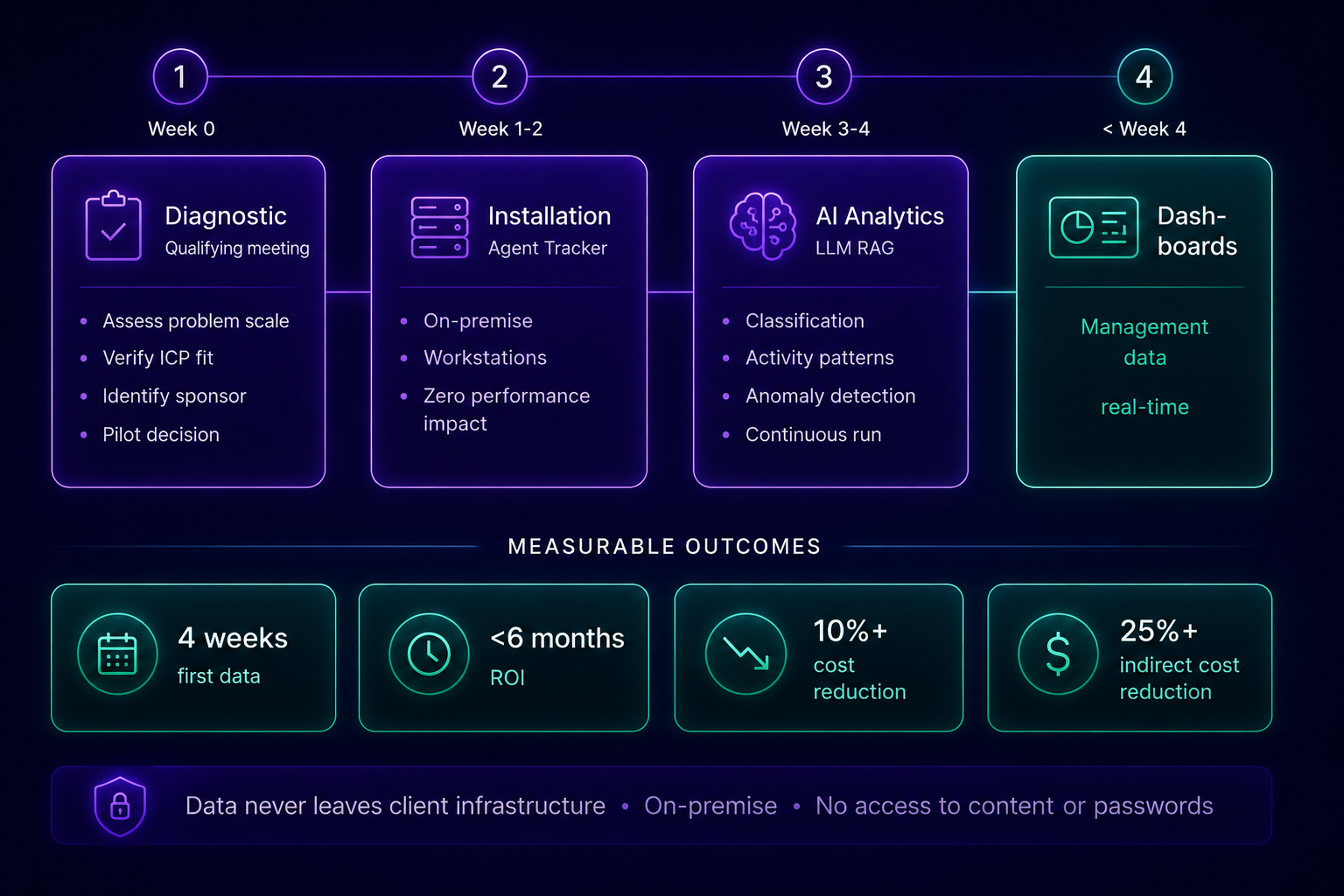
During this meeting, we jointly assess whether the issue has enough financial impact to justify implementation. We review the scale of external IT resources, contractor and body leasing budgets, current productivity measurement methods, and key visibility gaps.
If the diagnostic confirms the potential, we propose a paid pilot to validate assumptions with real data before full implementation. This focused IT operational audit service delivers value before further commitment.
How much of your monthly B2B budget - at the 1 million level - actually translates into productive work?
→ Assess the scale of leakage in your external IT spending


