Skip to content
News & Events

document-m
News
Stay up to date with the latest company updates, industry insights, and technology trends.
edi-m
Blog & Knowledge hub
Gain expert perspectives and practical knowledge through articles, case studies, and industry analyses.
AI AGENTS

Automate conversations, decisions, and workflows with human-like AI precision.

Salesforce Marketing Cloud

Maximize ROI with Salesforce Marketing Cloud

Mar 04, 2026

Summary: Salesforce Marketing Cloud (SFMC) helps you orchestrate personalized, data-driven campaigns at scale so you can turn every interaction into measurable business value. To truly maximize ROI, you need to understand its features, connect it tightly with your CRM, and build a disciplined analytics and optimization practice on top. Many organizations strengthen outcomes by using Salesforce Marketing Cloud services and experienced Salesforce Marketing Cloud consultants to accelerate CRM integration and marketing analytics maturity.
Salesforce Marketing Cloud

Understanding Salesforce Marketing Cloud

Salesforce Marketing Cloud is a cloud-based digital marketing platform that supports email, mobile, social, advertising, and web personalization in one environment. It is part of the broader Salesforce Customer 360 ecosystem, which means it connects natively with Sales Cloud, Service Cloud, and Data Cloud for unified customer engagement.

SFMC is organized into applications such as Email Studio, Mobile Studio, Social Studio, Journey Builder, Advertising, and Intelligence, each focused on a specific channel or function. You can start with a single module and expand over time, making it suitable for both growing businesses and large enterprises with complex needs.

Overview of Salesforce Marketing Cloud Features

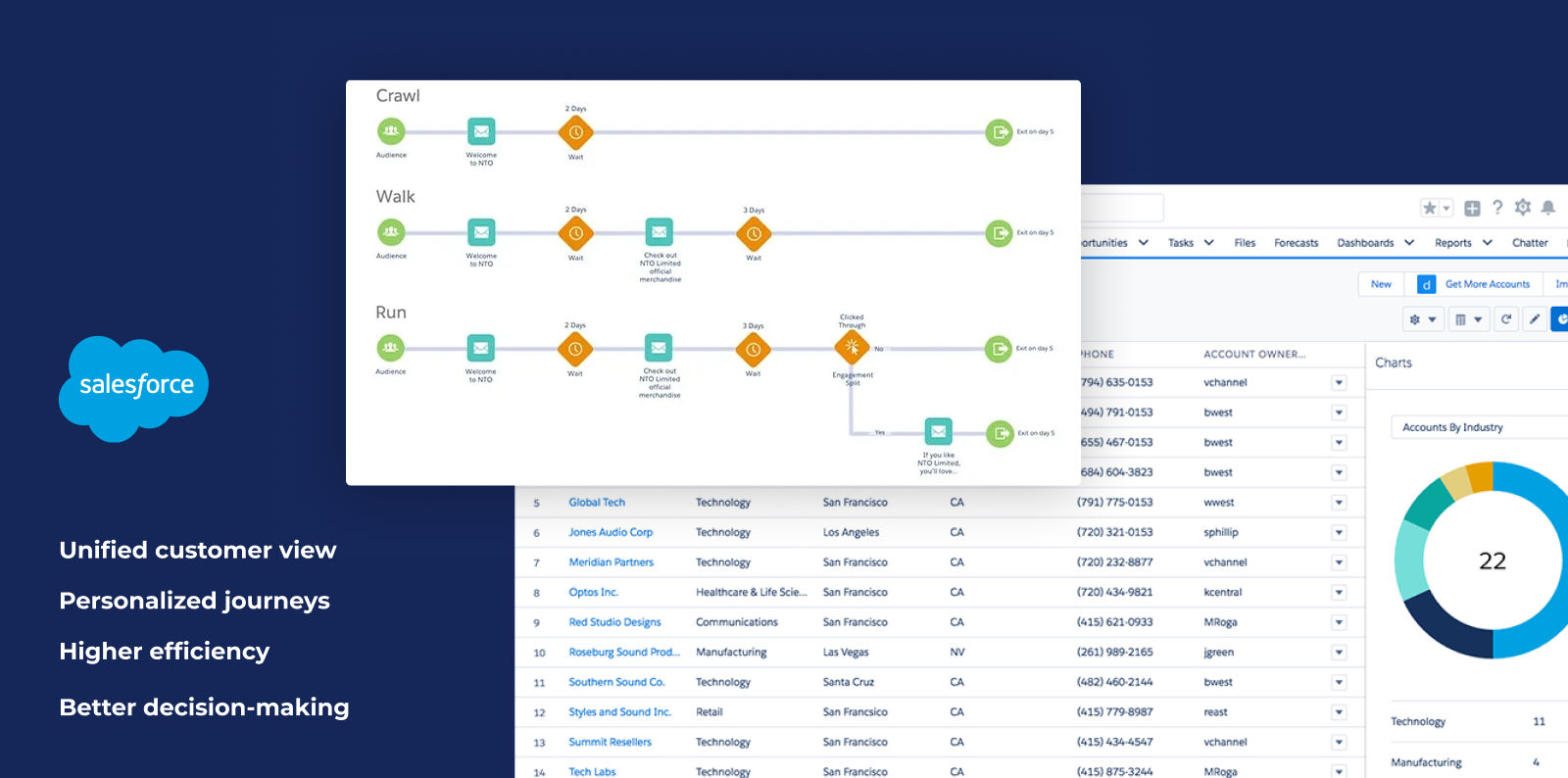
Core Salesforce Marketing Cloud features span messaging automation, data and audience management, and analytics. You can automate campaigns with Journey Builder, manage and segment audiences with Audience Builder and Data Cloud, and create content with Content Builder for email, SMS, and other channels.

The platform also includes tools for social media management, advertising audience synchronization, and advanced analytics that track engagement and performance across channels. With AI (Einstein) built into many features, SFMC can optimize send times, recommend content, and score leads automatically. Taken together, these Salesforce Marketing Cloud features support end-to-end orchestration, measurement, and optimization. 

Key Benefits of Using Salesforce Marketing Cloud

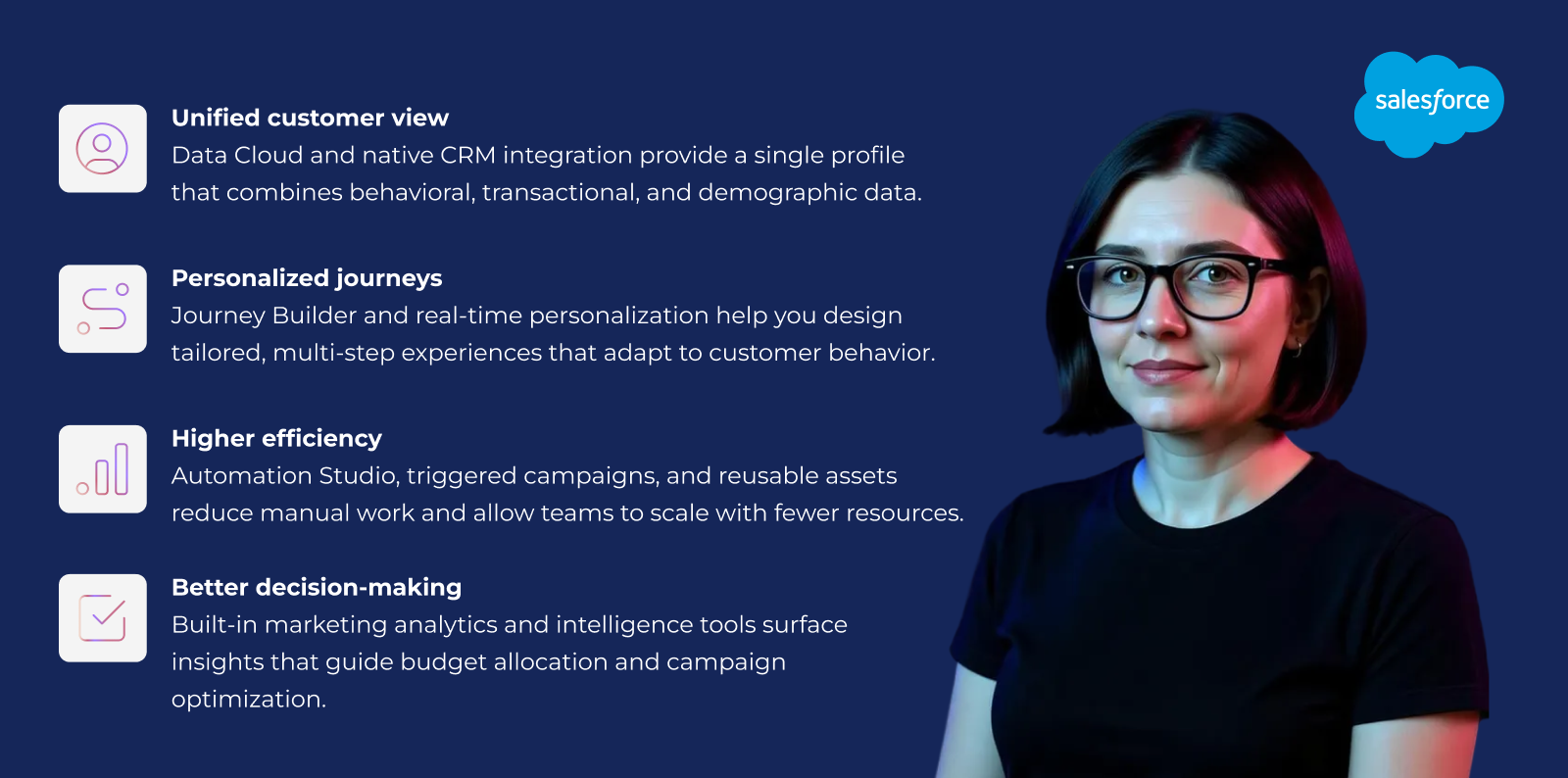
Salesforce Marketing Cloud delivers several ROI-focused benefits when properly implemented:
Salesforce Marketing Cloud

When these benefits are aligned with specific business goals such as lead generation, upsell, or retention, the platform can significantly improve marketing-driven revenue.

The Importance of Marketing Analytics

Marketing analytics in Salesforce Marketing Cloud transform raw engagement data into actionable insights. Rather than only tracking opens and clicks, you can measure how campaigns influence conversions, pipeline, and lifetime value.

Accurate analytics help you identify your most profitable segments, campaigns, and channels, making it easier to direct budget where it has the greatest impact. They also reveal underperforming journeys and bottlenecks in the funnel so you can refine content, timing, or targeting.

How Analytics Can Drive ROI

Analytics drive ROI when you use them to systematically test, learn, and optimize. For example, by comparing journeys with and without behavioral triggers, you can quantify how real-time personalization affects conversion and then standardize the best-performing approach.

Attribution and funnel analysis can also help you understand the ways various channels collaborate. For example, you might explore how email and paid media together impact the pipeline in B2B situations.

These insights let you reallocate spend away from low-impact tactics and double down on high-impact ones, directly increasing return on marketing investment.

Tools and Features for Effective Marketing Analytics

Salesforce provides several tools and features to support robust marketing analytics:

  • Marketing Cloud Intelligence: Aggregates data from multiple sources and delivers dashboards, reports, and AI-powered insights.

  • Journey and campaign analytics: Track performance within Marketing Cloud Engagement, including journey-level metrics and cross-channel engagement.

  • Data Cloud: Unifies data from Salesforce CRM and external systems, enabling more advanced segmentation and analytics.

By combining Intelligence dashboards with Data Cloud and native reporting, marketers can move from basic reporting to predictive and prescriptive analytics. This analytical foundation is essential for making informed decisions about campaigns, segments, and investment levels.

CRM Integration: A Game Changer

Tight CRM integration is one of the main reasons Salesforce Marketing Cloud can deliver strong ROI. When SFMC is integrated with Sales Cloud or Service Cloud, marketing and sales work from the same customer records, activity history, and engagement data.

This integration makes it possible to:

  • Trigger journeys from CRM events (new leads, opportunity stage changes, support cases).

  • Sync lead and contact data for accurate segmentation and personalization.

  • Feed engagement data (email opens, clicks, conversions) back into CRM for sales visibility and better follow-up.

Benefits of Integrating CRM with Marketing Cloud

Integrating Salesforce CRM with Marketing Cloud offers several clear benefits:

  • Improved lead quality and routing: Marketing can score and nurture leads in SFMC, then pass sales-ready leads directly into Sales Cloud with full context.

  • Consistent customer experiences: Sales and service teams see marketing engagement history, enabling more relevant conversations and follow-up.

  • More accurate reporting: End-to-end visibility enables reporting on how campaigns influence pipeline stages, win rates, and revenue rather than just clicks.

Overall, CRM integration shortens feedback loops between marketing and sales, leading to better use of budget and higher conversion rates.

Effective Salesforce Marketing Cloud Implementation Services

Salesforce Marketing Cloud implementation services help organizations plan, configure, and roll out SFMC in a way that fits their processes and objectives. Specialists typically assist with requirements gathering, solution design, technical setup, integration, data modeling, and initial journey builds.

Professional Salesforce Marketing Cloud services and Salesforce Marketing Cloud consultants can also guide you on governance, permission models, and best practices for data quality and compliance. This foundational work ensures that campaigns, analytics, and integrations are structured correctly from day one, which is critical for long-term ROI.

Choosing the Right Consulting Partner: Essential Steps in the Implementation Process

Selecting a Salesforce Marketing Cloud consulting partner is a strategic decision with direct impact on outcomes. Look for certified SFMC specialists with proven experience in your industry, as well as strong capabilities in data, integration, and marketing strategy.​

Key steps in the implementation process typically include:

  • Discovery and goal definition: Align on business objectives, KPIs, and use cases for SFMC.

  • Architecture and integration design: Plan how Marketing Cloud will connect with Salesforce CRM, data warehouses, and external systems.

  • Configuration and build: Set up studios, data extensions, and journeys, and configure user roles and security.

  • Testing and training: Validate integrations and journeys, then train marketing, sales, and analytics teams on daily operations.

A strong partner will also propose a roadmap for continuous optimization, not just a one-time deployment.

Conclusion

Salesforce Marketing Cloud offers a powerful combination of multichannel automation, deep marketing analytics, and native CRM integration that together create a strong foundation for profitable, data-driven marketing. By understanding its key features, from Journey Builder and Email Studio to Intelligence and Data Cloud, you can design personalized experiences that move customers smoothly from awareness to loyalty.

When you integrate Salesforce CRM, you unlock a single, shared view of each customer, enabling better lead management, more relevant conversations, and end‑to‑end measurement of campaign impact. With a thoughtful implementation, guided by experienced consultants and anchored in clear business goals and KPIs, SFMC becomes more than just a tool - it becomes the operational backbone of your marketing strategy. Ultimately, organizations that commit to continuous optimization, cross‑team collaboration, and disciplined use of analytics are the ones that see the highest ROI from Salesforce Marketing Cloud.


Go to

Lates News