Skip to content
News & Events

document-m
News
Stay up to date with the latest company updates, industry insights, and technology trends.
edi-m
Blog & Knowledge hub
Gain expert perspectives and practical knowledge through articles, case studies, and industry analyses.
AI AGENTS

Automate conversations, decisions, and workflows with human-like AI precision.

salesforce marketing cloud implementation

Mistakes to Avoid During Salesforce Marketing Cloud Implementation

Mar 04, 2026

Summary: This article explains the five most common pitfalls, their impact on performance and ROI, and how to avoid them through better planning, stronger focus on data, and collaboration with an experienced implementation partner so you can unlock the full potential of Salesforce Marketing Cloud faster.

Salesforce Marketing Cloud implementation is a major investment that touches data, marketing operations, and customer experience across channels. Avoiding a few recurring mistakes can significantly reduce go‑live delays, rework, and poor adoption.

Mistake #1: Insufficient Stakeholder Engagement

Importance of identifying key stakeholders

Many implementations start as “just a marketing project” and fail to bring in IT, sales, service, data, and compliance stakeholders early enough. For Salesforce Marketing Cloud, you typically need representation from marketing operations, CRM owners, data/BI, security, legal, and regional business units to define requirements and constraints.

Involving a Salesforce Marketing Cloud implementation partner can help map stakeholders and run structured discovery workshops that capture goals, journeys, data needs, and integration points. Partners are used to translating between technical and non‑technical teams and can surface hidden dependencies, such as data residency or consent rules, before configuration starts.

Consequences of poor communication

Without aligned stakeholders, teams often discover conflicts late, such as overlapping campaigns, clashing send calendars, or unsupported data flows between CRM and Marketing Cloud. This leads to rushed changes, broken customer journeys, and mistrust of the platform when early campaigns underperform.

Ineffective communication can raise the risk of security or compliance issues, such as when consent and preference data aren't properly set up across systems. This oversight may lead to expensive fixes after the launch.

In contrast, regular steering meetings, shared documentation, and clear RACI for decisions keep everyone aligned on scope, timelines, and responsibilities.

Mistake #2: Neglecting to Define Clear Goals

Setting measurable objectives

Many organizations implement Salesforce Marketing Cloud with generic aims like “better personalization” but no measurable objectives. Effective projects define specific KPIs, such as uplift in email revenue, cart‑recovery conversion, onboarding completion rates, or reduction in manual campaign build time.

These KPIs should be tied to concrete use cases planned for the first 3–6 months, such as a multi‑step welcome journey or a churn‑prevention program.

Adding metrics to early journeys gives you a starting point to improve. It also helps show why continued support for Salesforce Marketing Cloud is important.

Aligning with business strategy

If goals are not tied to wider commercial and customer‑experience strategies, Marketing Cloud can become an isolated tool rather than a growth lever. Alignment means mapping capabilities like cross‑channel orchestration, segmentation, and real‑time triggers to strategic initiatives such as international expansion or subscription retention.

A seasoned Salesforce Marketing Cloud implementation partner will usually start with a discovery phase that links platform roadmap, licenses, and architecture to your business strategy, not just to a feature checklist. This strategic framing also guides future phases like adding new studios, integrating more data sources, or rolling out to additional regions.

Mistake #3: Inadequate Training and Support

The role of a Salesforce Marketing Cloud implementation partner

Under‑investing in enablement is one of the fastest ways to stall adoption and limit ROI from Salesforce Marketing Cloud. Teams that only receive basic handover sessions often revert to old tools or struggle to build and maintain journeys without constant external help.

A strong Salesforce Marketing Cloud implementation partner usually offers structured enablement that goes well beyond technical configuration. Typical support includes discovery and solution design, best‑practice data modeling, integration setup (for example Marketing Cloud Connect with Salesforce CRM), and documentation tailored to your use cases.

Partners with dedicated Marketing Cloud consultants can also mentor your internal admins and marketers through the first campaigns, ensuring they understand journey logic, content building, testing, and monitoring performance. This shared delivery model shortens the learning curve while building in‑house capability rather than locking you into permanent external dependency.

Providing ongoing training resources

Marketing Cloud evolves frequently, and new features, channels, and compliance requirements appear regularly. Treating enablement as a one‑time project activity means your team quickly falls behind, especially as you expand into more advanced use cases or onboard new hires.

Effective organizations create a continuous learning plan, combining formal training, internal playbooks, and office‑hours from their partner or internal experts. This often includes documented templates and checklists for building journeys, QA and testing procedures, and standardized reporting dashboards so campaigns are consistent across teams and markets.

Mistake #4: Overlooking Data Management

Importance of data quality

Salesforce Marketing Cloud is only as powerful as the data you feed into it. Poorly maintained contact data, duplicated profiles, missing consent flags, or inconsistent identifiers across systems will undermine segmentation and personalization efforts.

Implementation should include a clear data‑quality strategy: defining primary keys for contacts, mapping sources like CRM and ecommerce, and deciding how to handle duplicates, inactive records, and bounced addresses. Many step‑by‑step implementation guides emphasize cleaning and migrating data before building journeys so that automations can run reliably from day one.

Implementing data governance

Beyond initial cleanup, you need ongoing data governance to keep Marketing Cloud usable and compliant over time. Governance covers who can create or modify data extensions, how long data is retained, how consent is stored and updated, and which business units can access specific customer segments.

A Salesforce Marketing Cloud implementation partner can help formalize these rules and configure them via roles, permissions, and business units. They can also advise on aligning Marketing Cloud data structures with enterprise governance policies around security, retention, and regional regulations.

Mistake #5: Not Utilizing All Features

Exploring marketing automation capabilities

Many teams stop at basic email campaigns and miss the broader automation capabilities of Salesforce Marketing Cloud. Key features like Journey Builder, real‑time triggers, dynamic content, and multi‑channel orchestration are often underused or postponed indefinitely.

Yet Salesforce Marketing Cloud is designed to deliver data‑driven, automated customer journeys that adapt to behavior across channels such as email, mobile, web, and advertising. When configured properly, marketing automation reduces manual work, improves targeting, and makes it easier to test and scale complex lifecycle programs.

Real‑world Salesforce Marketing Cloud use cases

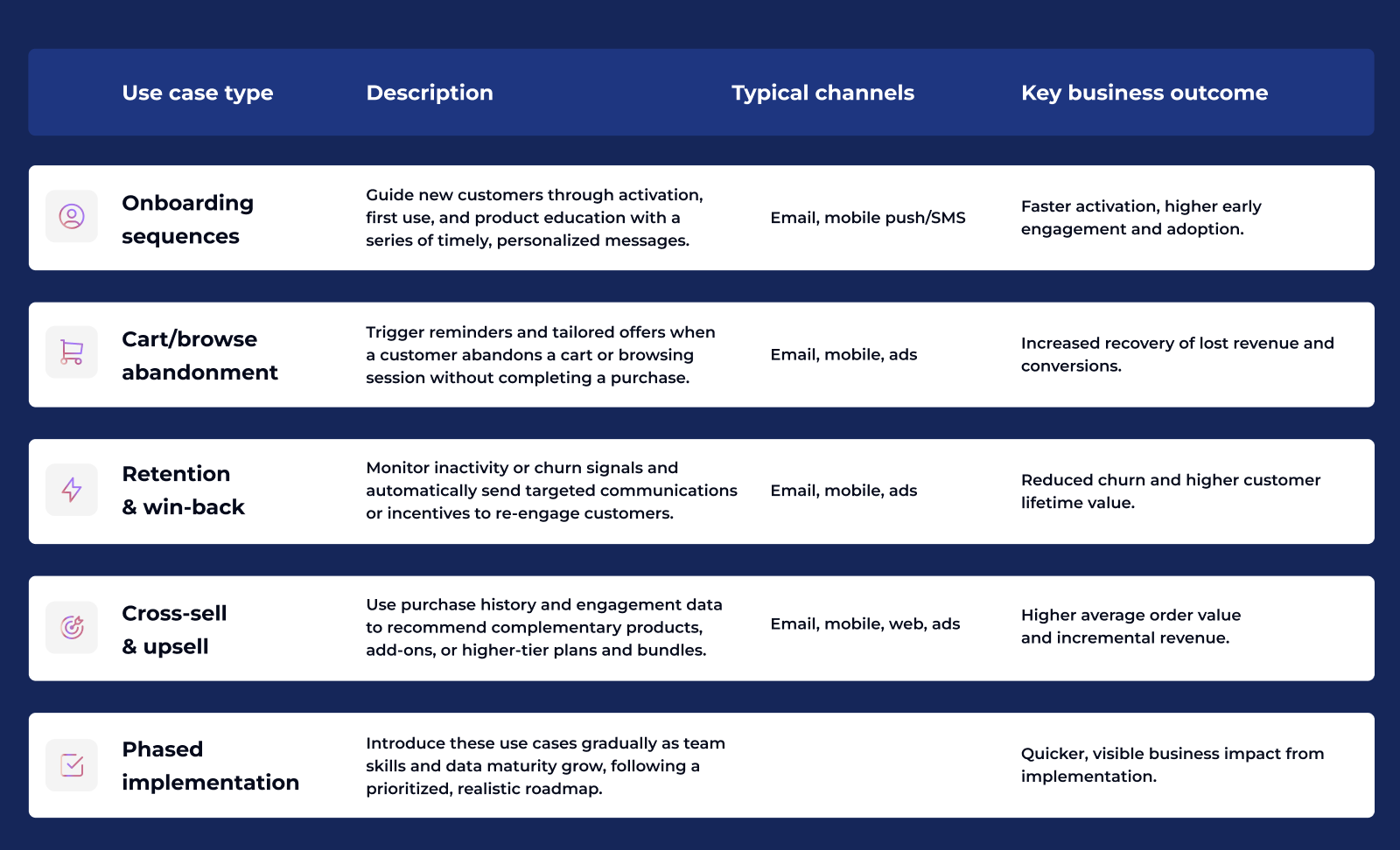
Across industries, successful Salesforce Marketing Cloud implementations share a set of practical, high‑value use cases. These can be phased in gradually as your team’s skills and data maturity grow.

Examples include:

  • Onboarding sequences that guide new customers through activation, first use, and product education across email and mobile.

  • Cart‑abandonment and browse‑abandonment campaigns in retail and ecommerce that trigger personalized reminders and offers based on customer behavior.

  • Retention and win‑back programs that monitor inactivity or churn signals and automatically deliver targeted communications or incentives.

  • Cross‑sell and upsell journeys that use purchase history and engagement data to recommend complementary products or upgrades.

By planning these Salesforce Marketing Cloud use cases into your initial roadmap, you increase the chances that your implementation quickly delivers visible business outcomes.
salesforce marketing cloud implementation


Summary of key points

Avoidable mistakes in Salesforce Marketing Cloud implementation typically involve stakeholder alignment, vague goals, weak enablement, unmanaged data, and underused capabilities. Addressing these areas early increases adoption, improves campaign performance, and keeps the platform aligned with business priorities rather than just technical requirements.

Organizations that partner with experienced Salesforce Marketing Cloud implementation services providers usually benefit from faster time‑to‑value, better solution design, and stronger governance. If you are planning or rescuing an implementation, engaging a certified Salesforce Marketing Cloud implementation partner can help you avoid these mistakes, design impactful use cases, and build sustainable internal capability.


Go to

Lates News