Nearshore IT Outsourcing Pricing Models: ALL you need to know
Summary: Nearshore IT outsourcing pricing models help decide how you pay your partner. They also show how risk is shared and how flexible you can be as your project changes. It's important to understand these models before you begin. This will help you avoid unexpected costs and create a smart outsourcing plan.
Introduction to Nearshore IT Outsourcing
Nearshore IT outsourcing means partnering with software development and IT teams in nearby or time‑zone‑aligned countries, typically within 1–4 hours of your own working day. It aims to blend cost savings with easier collaboration, cultural affinity, and real‑time communication compared with distant offshore locations.
Nearshore software development pricing models mirror general IT outsourcing structures but often emphasize flexibility and long‑term collaboration. For international businesses, nearshore can deliver a strong balance of predictable costs, access to skilled talent, and faster delivery cycles.
Definition and Benefits
Nearshore IT outsourcing covers services such as custom software development, DevOps, QA, cloud engineering, and support delivered from nearby regions. Being close in location and time zones helps us meet easily. It makes daily check-ins and teamwork with our teams and outside partners easier.
The main advantages are reduced costs compared to local hiring, smoother communication than with many overseas arrangements, and quicker onboarding with pre-assembled teams. When matched with the right pricing model, nearshore can become a cost‑effective outsourcing solution rather than a short‑term cost‑cutting tactic.
Comparison with Offshore and Onshore Outsourcing
Onshore outsourcing keeps all work in the same country, providing maximum alignment but at the highest labor cost. Offshore outsourcing focuses on countries far away with lower costs, providing the cheapest hourly rates. However, it often brings more challenges with time zones and collaboration.
Nearshore sits in the middle, with rates typically higher than offshore but lower than onshore, and with better time‑zone overlap and cultural compatibility than many offshore destinations. This middle ground makes pricing model choice especially important to fully realize value from nearshore partnerships.
Overview of Nearshore IT Outsourcing pricing models
Nearshore IT outsourcing pricing models usually fall into four main categories: fixed price, time and materials, dedicated team, and value‑based pricing. Each model distributes budget predictability, flexibility, and risk differently.
Choosing between nearshore software development pricing models depends on project scope, uncertainty, duration, and how closely you want to manage the team. Many companies also adopt hybrid approaches over the lifecycle of a product.
Fixed Price Model
The nearshore IT fixed price model sets a predetermined amount for a clearly defined project scope, timeline, and deliverables. You agree on requirements upfront, receive a total cost, and pay that amount as milestones are delivered.
Advantages include strong budget predictability and clear expectations for both parties. However, this model offers limited flexibility; changes to scope require change requests, which can increase cost and extend timelines.
Time and Materials Pricing
Nearshore IT time and materials pricing charges based on actual hours worked and resources consumed, often at agreed hourly or daily rates. This model is common for agile development, product discovery, and evolving requirements.
Its strength is flexibility: you can adjust scope, priorities, and backlog without renegotiating contracts. The trade‑off is less budget certainty, so you need strong project management and cost tracking to avoid overspending.
Dedicated Team Pricing Model
In a dedicated team pricing model, you pay a fixed monthly fee for a stable nearshore team that works exclusively on your projects. This usually includes developers, QA testers, and sometimes a scrum master or architect. The rates depend on the size of the team and their experience level.
The dedicated team model offers predictable monthly costs, deep knowledge retention, and high alignment with your internal processes. It is particularly suitable for long‑term products, continuous roadmaps, and organizations seeking nearshore capacity functioning as an extension of their in‑house team.
Value-Based Pricing
Value‑based nearshore outsourcing links pricing to business outcomes or value delivered rather than hours or scope alone. Examples include pricing tied to usage metrics, performance improvements, or revenue impact.
This model encourages both parties to focus on results instead of just inputs and can strengthen strategic alignment. It requires mature measurement, trust, and clear value metrics, so it is less common but increasingly discussed as outsourcing relationships evolve.
Factors influencing Nearshore Software Development rates
Nearshore software development rates vary widely across regions, partners, and project types. Understanding the main cost drivers helps you benchmark proposals and negotiate realistic budgets.
Key factors include geographic location, developer skill level, tech stack, project complexity, and local market demand. Economic conditions and currency fluctuations in nearshore countries can also influence pricing over time.
Geographic Location
Geographic location is one of the strongest determinants of nearshore rates, as labor costs differ significantly between regions. For example, nearshore teams in Eastern Europe or Latin America often charge lower rates than teams in Western Europe or North America while still offering overlapping time zones.
Within each region, cities with higher living costs and stronger tech ecosystems may charge premium rates. Companies often compare multiple nearshore hubs to balance budget, talent availability, and regulatory comfort.
Developer Skill Level
Developer seniority, specialization, and experience directly influence nearshore software development rates. Senior engineers, solution architects, and experts in high‑demand fields like AI, cybersecurity, or cloud command higher hourly or monthly costs.
Projects that require niche skills or advanced architecture design will therefore cost more than those relying mostly on mid‑level, generalist developers. Transparent skill matrices and blended teams (mixing junior, mid, and senior profiles) help optimize cost and capability.
Project Complexity
Project complexity—functional breadth, integrations, performance needs, and compliance requirements—is another major cost driver. Simple applications with limited logic and integrations sit at the lower end of cost ranges, while complex, enterprise‑grade solutions can exceed several hundred thousand dollars.
Factors like custom integrations, data security standards (e.g., GDPR, HIPAA), scalability targets, and AI/automation features significantly increase effort and, therefore, cost. Complex projects also tend to favor flexible pricing models like time and materials or dedicated teams over rigid fixed price.
Cost comparison: Nearshore vs. Offshore development costs
Comparing nearshore and offshore development costs means looking at more than headline hourly rates. While offshore often appears cheaper on paper, nearshore can be more economical when you include productivity and collaboration factors.
Nearshore rates generally sit in the mid‑range between onshore and offshore, reflecting savings from lower labor costs plus added value from time‑zone alignment. For many organizations, this trade‑off is attractive for critical or evolving systems.
Breakdown of Costs
Offshore development costs commonly range from lower hourly rates but with greater overhead for communication, handovers, and project governance. Nearshore development costs are somewhat higher per hour but benefit from reduced coordination friction and faster decision‑making.
Additional cost components include recruitment and ramp‑up time, management overhead, tooling, travel for on‑site visits, and potential rework from misaligned expectations. Nearshore models can reduce some of these line items due to closer collaboration and easier in‑person workshops.
Long-term cost benefits of Nearshore Solutions
Over the long term, nearshore partnerships can improve total cost of ownership by reducing delays, quality issues, and turnover. Stable nearshore teams familiar with your domain can deliver more value per sprint than constantly rotating offshore resources.
Time‑zone overlap also accelerates time‑to‑market, which has direct financial impact for digital products and internal transformation projects. When viewed over several years, these factors often make nearshore a cost‑effective outsourcing solution despite somewhat higher rates than offshore.
Selecting the right pricing model for your project
Choosing among nearshore IT outsourcing pricing models is a strategic decision that should align with your product roadmap, risk tolerance, and internal capabilities. The “best” model depends on how clearly you can define scope, how long the engagement will last, and how much control you want.
In practice, many organizations use different models at different stages—such as time and materials for discovery, followed by fixed price for well‑defined modules, and dedicated teams for ongoing development. The key is to match the model to each phase’s uncertainty and business priorities.
Assessing project requirements
Start by clarifying project goals, scope stability, and time horizons. If requirements are fixed and short‑term, a fixed price model can work; if they are evolving or you need experimentation, time and materials or dedicated teams are better.
Assess internal product ownership and management capacity as well: more flexible models require stronger internal leadership to guide prioritization and maintain alignment. Also consider compliance, security, and integration complexity, which tend to favor more collaborative, iterative engagement.
Pros and Cons of each pricing model
Each nearshore IT outsourcing pricing model has distinct strengths and limitations. The table below captures key pros and cons to guide selection.
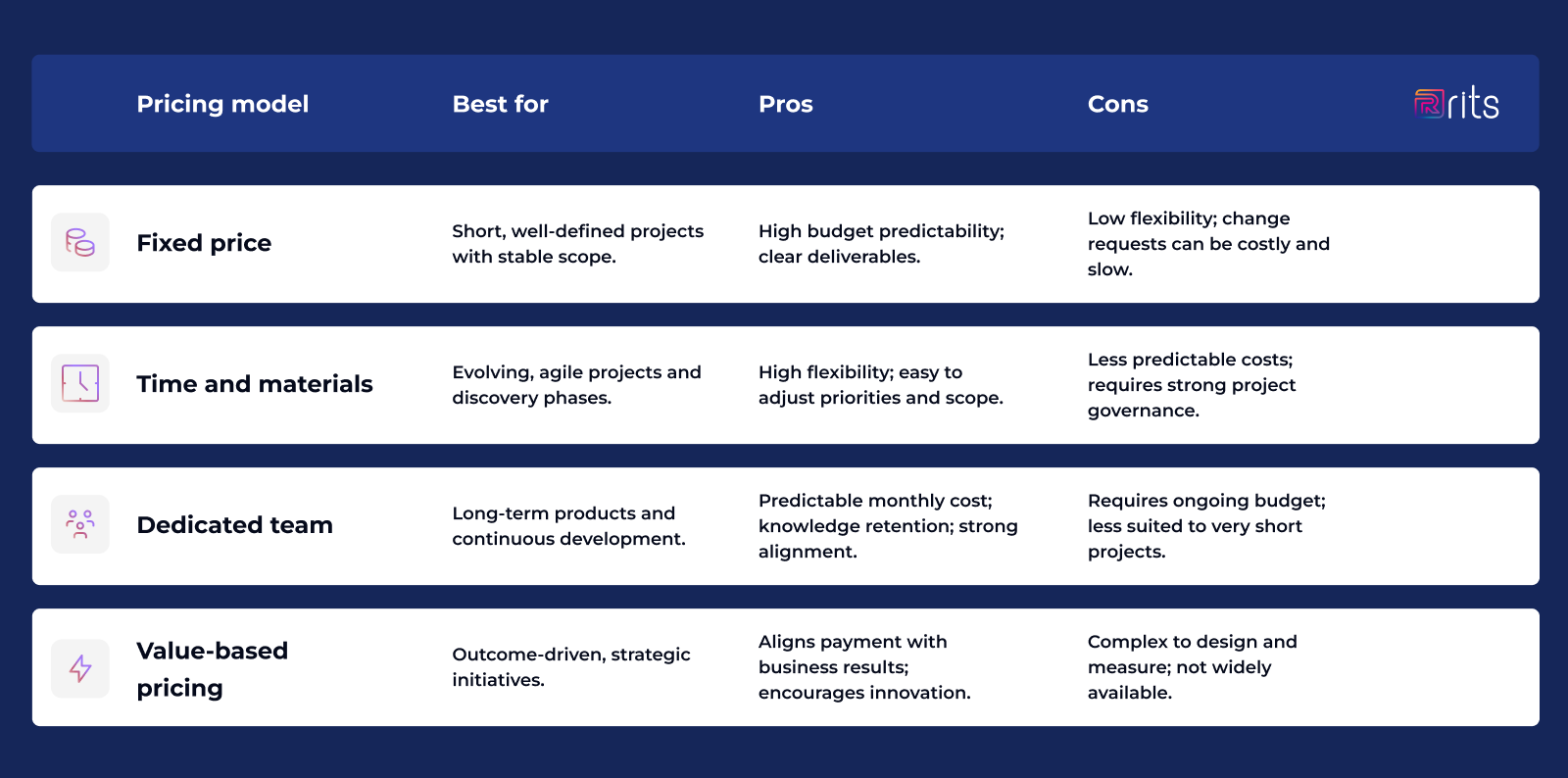
By mapping your project characteristics to these trade‑offs, you can select a model that minimizes surprises and maximizes value. For many organizations, a dedicated nearshore team combined with occasional fixed price or T&M projects offers an effective balance.
Best practices for cost-effective Outsourcing solutions
Maximizing the value of nearshore IT outsourcing pricing models requires careful planning, governance, and ongoing alignment. Even the most suitable model can underperform without disciplined execution.
Core best practices include structured budget planning, transparent communication, outcome‑based metrics, and deliberate quality management. Treating your nearshore partner as a strategic extension of your team rather than a transactional vendor is equally important.
Budget Planning and Management
Define a clear budget framework before engagement, including contingency for change and risk. For time and materials or dedicated team models, set monthly or quarterly spending ranges and implement tracking dashboards.
Align finance and delivery functions so that changing priorities do not result in uncontrolled cost growth. Regular financial reviews with your nearshore partner help surface optimization opportunities around team composition, scope trimming, or technical debt.
Ensuring Quality While Controlling Costs
Cost savings should not come at the expense of quality, especially for customer‑facing systems. Ensure your pricing model includes time for QA, test automation, code reviews, and security hardening.
Define quality metrics (defect rates, lead times, uptime) and incorporate them into contracts, performance reviews, or even value‑based components where appropriate. Investing in clear requirements, technical design, and documentation upfront will also reduce rework and hidden costs, regardless of the pricing model.
Conclusion and key takeaways
Nearshore IT outsourcing pricing models—fixed price, time and materials, dedicated team, and value‑based—offer different balances of predictability, flexibility, and risk. Understanding how these models work, and the factors that drive nearshore software development rates, is crucial before you sign any contract.
For many international businesses, nearshore partnerships become most powerful when pricing models align with project complexity, timeline, and desired collaboration level. By combining thoughtful model selection with disciplined budgeting and quality practices, you can build cost‑effective outsourcing solutions that support long‑term digital growth.