

Data & AI
We turn complex data into clear insights, helping leaders make smarter decisions and drive growth.
Discover how Data & AI are transforming strategies into measurable growth.
Redefine customer management with self-optimizing, intelligent CRM ecosystems.
Build meaningful relationships through data-powered loyalty and real-time personalisation.
Automate conversations, decisions, and workflows with human-like AI precision.

From customer experience (CX) managementhas become one of the key strategic areas for companies operating in the digital environment. Increasing competition, rising customer expectations and easy access to alternatives mean that the quality of experience at every stage of contact with a brand directly affects business performance, loyalty and long-term customer value.
In this article, we present the top 16 Customer Experience tools for 2025, based on industry analysis and current trends in CX, AI and digital experience.
Customer Experience (CX) is the entirety of a customer's experience resulting from interactions with a brand - from initial contact to after-sales service.
Effective CX management is based on:
Modern Customer Experience tools allow companies to:
In 2025, CX is no longer an advantage - it's a market standard.
A comprehensive CX and UX tool offering:
heatmaps
recordings of user sessions
conversion tracking
SEO and UX optimization support
Best for: conversion optimization and UX
One of the most popular customer service tools:
Best for: scaling customer service
A platform for managing CX in digital channels:
Best for: social media CX management
An advanced CX platform that integrates:
Best for: large organizations (enterprise)
All-in-one platform:
Best for: SMEs and scaling companies
Customer feedback analysis tool:
Best for: Voice of Customer (VoC)
Advanced UX analytics:
visualizing user paths
identification of UX problems
Best for: user behavior analysis
Data analysis tool:
Best for: campaign and audience analysis
An omnichannel platform with AI:
Best for: CX automation
A platform for collecting real-time feedback:
Best for: enterprise CX
Solutions for:
Best for: CRO and personalization
Voice of Customer System:
Best for: improving service quality
CX analytics:
Best for: large organizations
UX research tool:
Best for: digital product design
Automating customer service using AI:
Best for: AI in customer support
A simple satisfaction survey tool:
Best for: rapid feedback collection
An advanced AI-based Customer Experience platform that combines analytics, automation and personalization in a single ecosystem. Synerise uses behavioral data and predictive models to optimize communications and customer experiences in real time.
Functionality:
Best for: companies that want to implement advanced personalization and decision-making based on AI
The selection of a tool depends on scale and business goals:
For SMEs:
For enterprise:
For AI automation:
For UX and conversion:
The best results come from combining tools with a well-designed CX strategy.
Personalization based on artificial intelligence is becoming the standard for building customer experiences. By analyzing behavioral data, purchase history and real-time interactions, companies can deliver tailored messages, product recommendations and dynamic content.
Automation, supported by AI and chatbots, allows companies to handle more inquiries with lower operational costs. Modern solutions can solve even complex problems without human intervention, while reducing response times and improving the quality of service.
A key trend is the shift from simple chatbots to intelligent AI agents.
Companies are increasingly making decisions based on real-time data. This allows them to respond immediately to user behavior, quickly detect problems and optimize the customer path on the fly.
Real-time analytics is becoming the foundation of modern CX.
Customers expect a seamless experience regardless of the channel: be it a website, mobile app, email, social media or phone contact.
In 2025, companies need to ensure that communications, interaction stories and service quality are fully consistent across all brand touchpoints.
Data fragmentation remains one of the biggest challenges. Integration of systems (CRM, marketing automation, support, analytics) enables the creation of a complete picture of the customer (the so-called single customer view).
This allows companies to better understand user needs and make more accurate business decisions.
Instead of reacting to problems, companies are increasingly anticipating customer needs and eliminating potential barriers even before they occur.
Systematic collection and analysis of customer feedback (NPS, CSAT, CES) is becoming a key component of business decision-making and product optimization.
Combining AI, RPA and analytics allows automating entire customer journey processes: from marketing to after-sales service.
Growing user awareness and regulations (e.g., GDPR) are driving the need for companies to combine personalization with responsible data management.
Customer Experience is no longer the domain of a single department - it is becoming a central element of an organization's strategy, influencing marketing, sales, product and customer service.
The development of Customer Experience tools shows that today it is not only technology that is crucial, but also the ability to connect data, processes and real customer needs. Implementation of a tool alone does not guarantee success - only its proper use as part of a coherent CX strategy brings tangible business results.
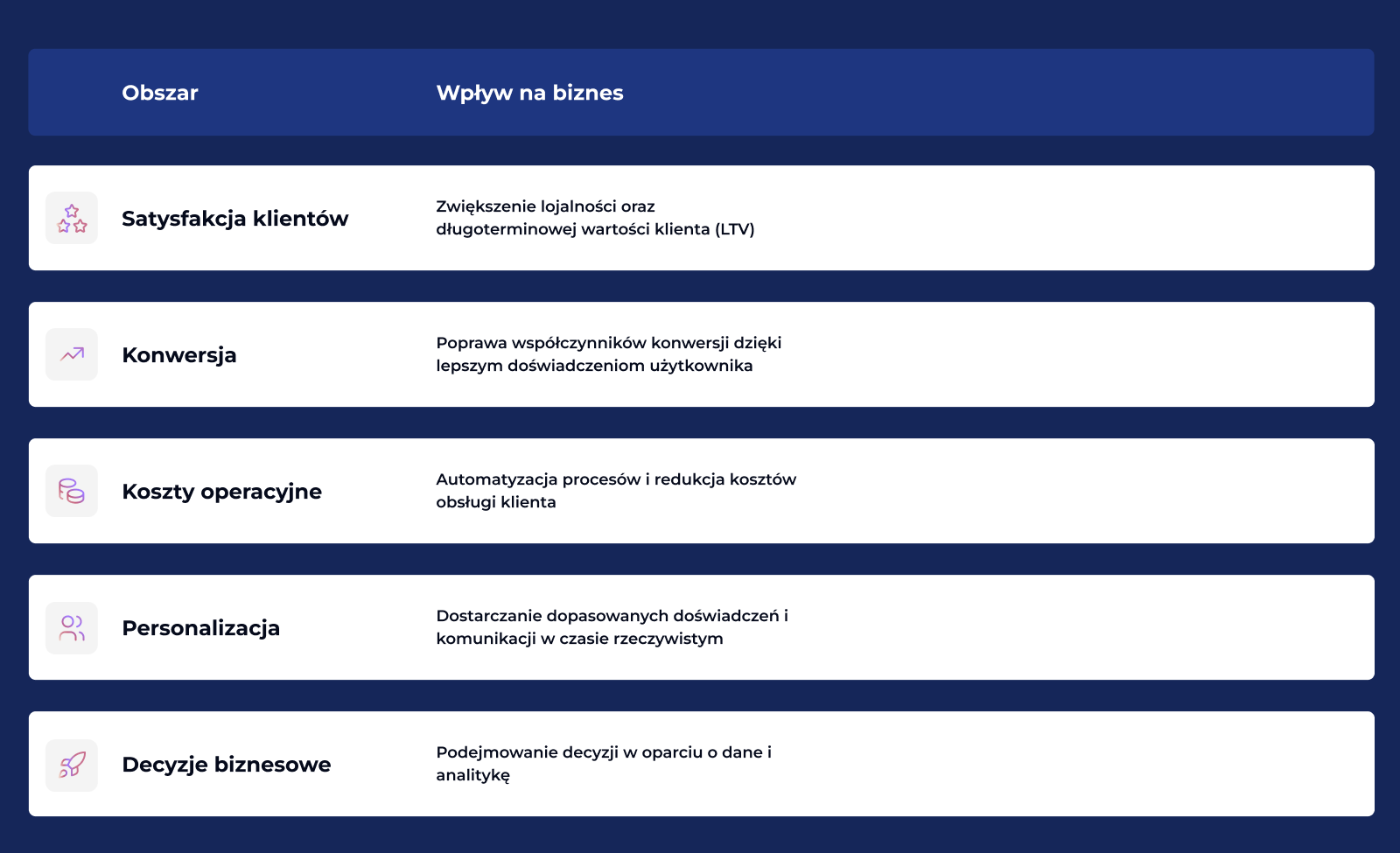
Companies that invest in Customer Experience:
In practice, this means moving from reactive customer service to proactive experience management: based on data, automation and personalization. Organizations that effectively implement CX are able to respond faster to changing market needs and build more consistent and valuable customer relationships.
In the context of the growing role of AI and automation, Customer Experience is becoming one of the key areas of digital transformation. CX tools are no longer just operational support - they are becoming the foundation of business growth and scaling strategies.
Therefore, choosing the right solutions, integrating them and continuously optimizing them should be treated as a strategic investment, not a cost.


