Unlocking the Power of Oracle Marketing Cloud
Summary: Oracle Marketing Cloud helps organizations worldwide build consistent, data‑driven campaigns and manage the full customer lifecycle across channels. By combining automation, real‑time analytics, and deep integration with the broader Oracle ecosystem, the platform supports both B2B and B2C teams in scaling marketing efforts internationally.
This article explains what Oracle Marketing Cloud is, why marketing automation matters, which features stand out, how it relates to Oracle Customer Experience Cloud, how it compares with Adobe Experience Cloud, and how Oracle’s cloud position shapes its future.
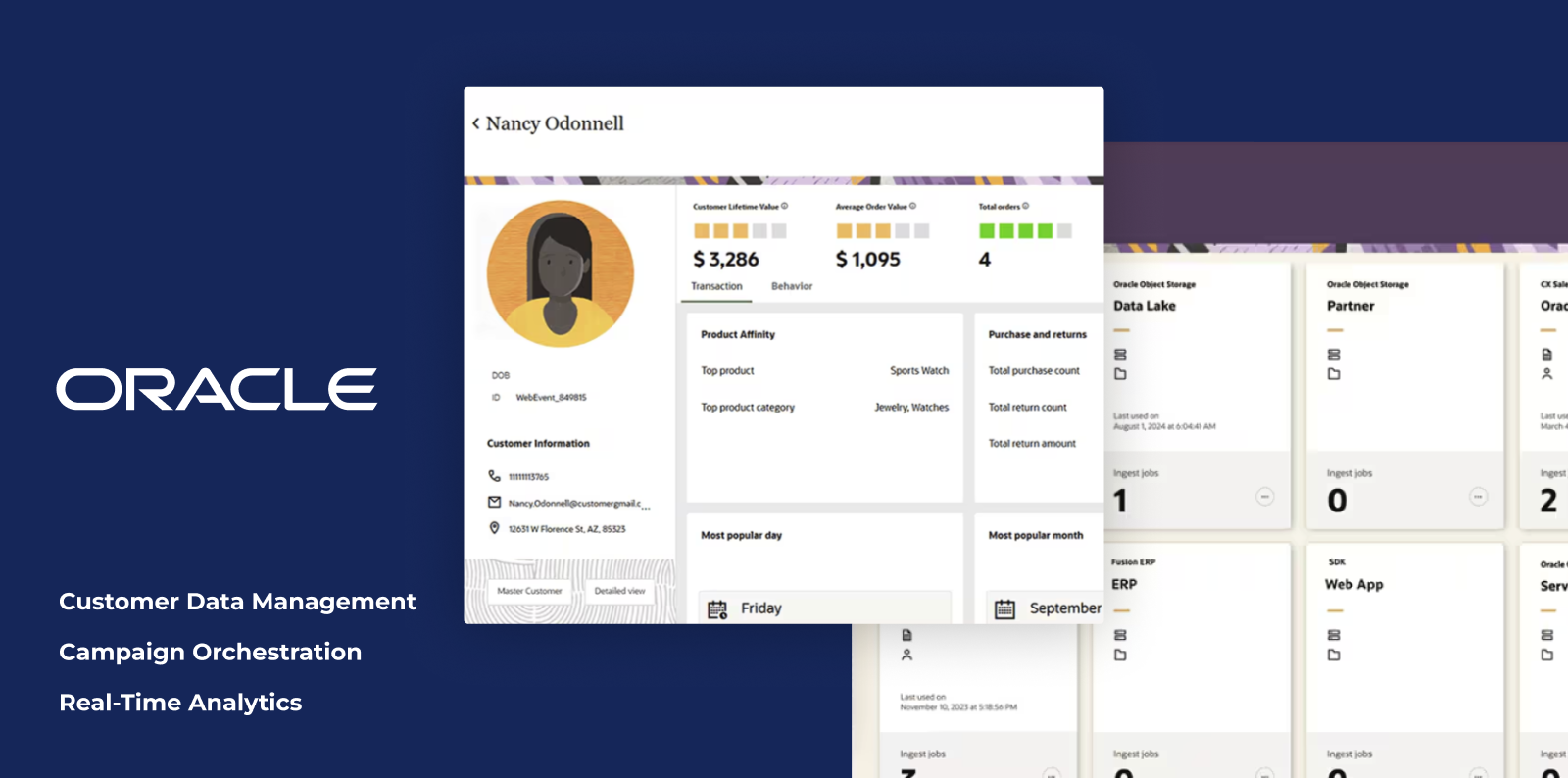
Importance of Marketing Automation in the cloud
Marketing automation has become a foundation of modern marketing strategies, especially for organizations operating across multiple regions. It automates repetitive tasks—such as segmentation, campaign delivery, and follow‑up—so marketers can focus more on strategy and creative work.
With automation, companies can:
-
React quickly to user behavior (e.g., abandoned carts, content downloads).
-
Apply consistent lead qualification and pass higher‑quality leads to sales.
-
Standardize processes across countries and teams while keeping room for local adaptation.
Oracle Marketing Cloud fits this trend by offering robust capabilities for building automated journeys and scoring leads and accounts.
Key Features of Oracle Marketing Cloud
Oracle Marketing Cloud delivers a broad feature set that covers data management, campaign orchestration, personalization, and analytics. Three pillars are particularly important: customer data management, campaign orchestration, and real‑time analytics.
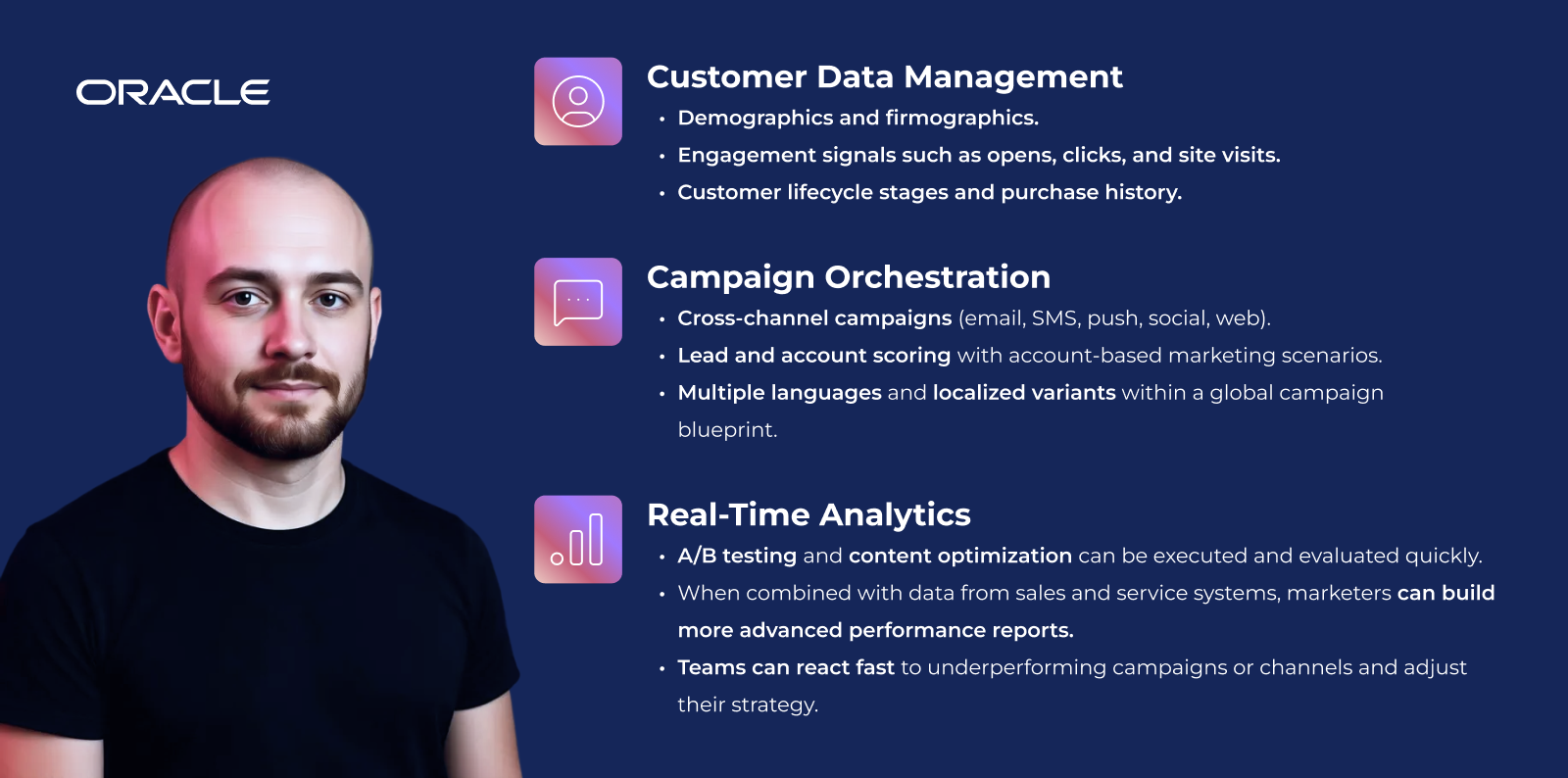
Customer Data Management
Customer data management sits at the core of Oracle Marketing Cloud. The platform consolidates customer information from forms, campaigns, websites, CRM, and transactional systems, building rich, multi‑dimensional profiles.
Marketers can then create precise segments based on:
-
Demographics and firmographics.
-
Engagement signals such as opens, clicks, and site visits.
-
Customer lifecycle stages and purchase history.
This level of detail significantly improves targeting, message relevance, and overall campaign performance.
Campaign Orchestration
Campaign orchestration enables marketers to design complex, multi‑step journeys that react dynamically to user behavior. A contact can follow different paths depending on whether they opened an email, clicked an offer, or visited a product page.
The platform supports:
-
Cross‑channel campaigns (email, SMS, push, social, web).
-
Lead and account scoring with account‑based marketing scenarios.
-
Multiple languages and localized variants within a global campaign blueprint.
For international organizations, this orchestration layer combines centralized control with the flexibility local teams need to be effective.
Real-Time Analytics
Real‑time analytics provide immediate visibility into campaign results. Key metrics such as open rates, click‑through rates, conversions, and attributed revenue are available in dashboards while campaigns are running.
In addition:
-
A/B testing and content optimization can be executed and evaluated quickly.
-
When combined with data from sales and service systems, marketers can build more advanced performance reports.
-
Teams can react fast to underperforming campaigns or channels and adjust their strategy.
Oracle Customer Experience Cloud and Integration Benefits
Oracle Customer Experience Cloud (Oracle Cloud CX) is a broader ecosystem that unifies marketing, sales, service, and commerce on a shared data foundation. Oracle Marketing Cloud is the marketing engine within this suite, focused on acquisition and engagement.
Integrating Oracle Marketing Cloud with other Oracle CX modules, CRM, and ERP systems delivers concrete benefits:
- A single, consistent customer view that combines transactional, service, and marketing data.
- Stronger marketing–sales alignment thanks to shared data and processes.
- Simplified integration and governance compared with stitching together many separate vendors.
For global organizations, this means lower technical complexity and more predictable long‑term costs.
Use Cases and Success Stories
Typical use cases for Oracle Marketing Cloud include:
- Long B2B sales cycles with sophisticated lead nurturing, scoring, and pipeline alignment.
- E‑commerce and retail programs such as abandoned cart campaigns, product recommendations, and loyalty messaging.
- Subscription and service businesses with structured onboarding, retention, and re‑engagement programs.
Organizations commonly report higher conversion rates, better lead quality, and improved marketing ROI through more accurate targeting and automation. Highly regulated industries—such as financial services or life sciences—often value the combination of marketing capabilities with strong security and compliance support.
Adobe Experience Cloud vs. Oracle Marketing Cloud
For many enterprises, the practical decision is Adobe Experience Cloud vs. Oracle Marketing Cloud. Both are advanced platforms, but they differ in emphasis and ecosystem fit.
Feature Comparison
-
Adobe Experience Cloud Centered on managing and optimizing digital experiences and content, tightly integrated with Adobe Experience Manager, Analytics, and Creative Cloud. It is a strong choice for brands that prioritize rich, creative web and app experiences and already rely heavily on Adobe’s design and content tools.
-
Oracle Marketing Cloud Strong in campaign orchestration, lead management, and integration with business systems such as CRM, ERP, and other Oracle CX applications. It is especially attractive for organizations already using Oracle solutions and looking to unify data and processes within a single ecosystem.
Pricing and Use Case Considerations
Pricing for both Adobe Experience Cloud and Oracle Marketing Cloud is typically customized based on modules, contact volumes, and deployment scale. When comparing options, organizations should consider not only subscription fees but also:
-
Integration and maintenance costs.
-
Availability of in‑house skills for each platform.
-
Alignment with existing infrastructure (e.g., whether the company is more “Oracle‑centric” or “Adobe‑centric”).
In practice:
-
A company with a strong Oracle footprint in ERP and CX will often lean toward Oracle Marketing Cloud.
-
A media or content‑driven business built around Adobe’s creative and web stack may naturally favor Adobe Experience Cloud.
Oracle Cloud Market Share and Outlook
Oracle holds a smaller share of the global cloud infrastructure market than the largest hyperscalers, but its share and cloud revenues are steadily growing. For marketing buyers, the key point is that Oracle continues to invest heavily in Cloud CX and marketing automation.
The industry‑wide shift toward multi‑cloud benefits providers like Oracle, since many enterprises mix infrastructure from several clouds while consolidating core business applications in one ecosystem. In that context, Oracle Marketing Cloud gains relevance wherever the connection between operational data and marketing data is critical.
Looking ahead, the rise of AI, real‑time data, and stricter privacy regulations will favor integrated platforms with strong data management and governance. Oracle Cloud CX, with Oracle Marketing Cloud at its center, is well positioned to serve organizations that need both advanced marketing capabilities and robust control over customer data.
Conclusion
Oracle Marketing Cloud is a mature marketing automation platform that unites customer data management, advanced campaign orchestration, and real‑time analytics. Combined with Oracle Customer Experience Cloud and other Oracle applications, it can become the backbone of customer experience strategies for international enterprises.
If you are considering adopting marketing automation or migrating from another system, start by auditing your current processes and system landscape, then run a focused pilot in one region or business unit. This will help you validate how well Oracle Marketing Cloud fits your goals and provide a clear path for scaling the solution globally.