Introduction
Large language models excel at reasoning, but their knowledge is limited to information available at training time. They may provide inaccurate answers or indicate missing information when asked about recent events or proprietary documents. Retrieval-augmented generation (RAG) addresses this by sourcing current information from external sources before generating a response. [1]
Agent RAG architecture builds on this approach by using autonomous AI agents instead of a single, fixed retrieval pipeline. These agents plan multi-step retrieval strategies, use various tools, validate outputs, and refine results to meet quality standards. This enables the system to handle complex, open-ended tasks that standard RAG pipelines cannot address effectively.
This guide covers agent RAG architecture, its significance, key differences from standard RAG, and best practices for effective design and implementation.
Why This Topic Matters
A 2024 survey by Andreessen Horowitz found that over 70 percent of enterprise AI projects in production use some form of RAG to ground outputs in verified data. As these projects mature, teams often encounter limitations with standard RAG, such as single-step retrieval, limited error recovery, and difficulty adapting when initial queries return irrelevant results.
Agent RAG architecture addresses these limitations and now supports autonomous research assistants, enterprise copilots, and multi-step decision-support tools in active deployment. Understanding this architecture is essential for anyone developing production AI systems. [2]
Key Concepts
What Is Retrieval-Augmented Generation (RAG)?
Retrieval-augmented generation adds a retrieval component to a language model. When a user submits a query, the system searches external knowledge sources, such as vector databases, document stores, or live web indexes, to find relevant passages. These passages are included in the model's context along with the original query, enabling the model to generate accurate and up-to-date responses. [1]
A standard RAG pipeline has three stages: indexing, which chunks and embeds documents into a vector store; retrieval, which performs semantic search at query time; and generation, where the language model synthesizes the retrieved context into a final answer. This approach is effective for straightforward questions but struggles with ambiguous, complex, or multi-source queries.
What Is an AI Agent?
An AI agent is a system where a language model serves as a reasoning engine. It observes its environment, decides on actions, executes them using tools, and iterates its plan based on results. Unlike a standard language model call that runs once, an agent operates in a loop, known as a ReAct loop (Reason, Act, Observe), until it gathers enough information to produce a satisfactory output.
Agents can use external tools such as search engines, databases, code interpreters, APIs, and file systems. They also maintain memory across steps, breaking complex goals into sub-tasks and tracking progress through each one.
What Is Agent RAG Architecture?
Agent RAG architecture integrates autonomous AI agents with retrieval-augmented generation pipelines. Here, retrieval becomes an agent-driven workflow. Rather than performing a single semantic search, the system uses an agent or a network of agents to break down the user's query, select retrieval strategies, execute multiple searches across sources, assess the quality of results, and refine or expand the search as needed. [2] [3]
Key insight: In standard RAG, retrieval is a fixed function called once. In agent RAG architecture, retrieval is a dynamic action the agent manages across multiple iterations and data sources.
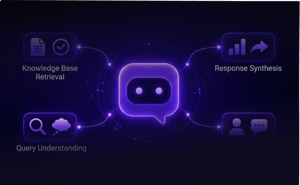
The architecture typically includes a planner agent to break down complex queries, one or more retriever agents for targeted searches, a critic or validator to score relevance and completeness, and a synthesizer to assemble the final response from verified content.
Importance and Benefits
Agent RAG architecture offers measurable advantages over pure language models and standard RAG pipelines. Experimental results show these systems achieve retrieval precision rates of about 85 percent and recall rates of about 80 percent on knowledge-intensive benchmarks, significantly outperforming standard single-pass pipelines. Key structural benefits include the following. [4]
- Higher accuracy: Multi-step retrieval and critic loops significantly improve accuracy on complex, multi-faceted queries.
- Multi-source retrieval: Ability to query structured data, APIs, and live web sources within a single orchestrated pipeline.
- Error resilience: Self-correction loops catch and recover from retrieval failures before they reach the generator.
- Persistent context: Memory modules maintain context across long sessions or multi-day workflows.
- Extensibility: Modular design allows new retrieval tools to be added without retraining the underlying model.
Standard RAG vs. Agentic RAG: A Direct Comparison
The table below highlights the architectural and capability differences between standard RAG and agent RAG systems. These differences clarify which approach is most appropriate for each use case.
|
Dimension
|
Standard RAG
|
Agentic RAG
|
|
Query Handling
|
Single-pass, static query expansion
|
Multi-turn, agent reformulates queries dynamically
|
|
Tool Use
|
Retriever only
|
Retriever plus web search, APIs, code execution
|
|
Memory
|
No persistent memory
|
Short-term and long-term memory modules
|
|
Reasoning
|
None
|
Chain-of-thought, reflection, and self-critique loops
|
|
Error Recovery
|
None
|
Self-correction via re-planning and re-retrieval
|
|
Latency
|
Low
|
Higher but adjustable via parallelism
|
|
Best Fit
|
FAQ bots, document lookup
|
Research agents, enterprise workflows, autonomous assistants
|
Standard RAG is ideal for well-defined, single-turn tasks that require speed. Agent RAG is better suited for open-ended queries, multiple sources, or situations where accuracy is essential.
Best Practices and Design Strategies
Strategy 1: Decompose Queries Before Retrieval
Complex queries almost always contain multiple distinct information needs bundled into a single sentence. Before any retrieval step, the planner agent should break the query into atomic sub-queries, each of which maps to a single, answerable information need. This decomposition dramatically improves retrieval precision because each sub-query can be matched against the most relevant source with a targeted embedding rather than a noisy composite embedding.
For example, the query 'Compare the latest EU AI Act requirements with current US federal AI guidelines and summarize the compliance gap for a fintech company' contains at least four distinct sub-queries: EU AI Act requirements, US federal AI guidelines, fintech-specific compliance obligations, and a gap analysis framework. A standard RAG system would embed and retrieve on the full sentence. An agent RAG system would generate and execute four separate retrieval calls, then synthesize the results.
Strategy 2: Use Hybrid Retrieval
No single retrieval method is optimal for all content types. Dense vector search (using embeddings) excels at semantic similarity but can miss exact terminology. Sparse retrieval methods such as BM25 perform better on keyword-heavy technical content. An agent RAG architecture should use hybrid retrieval, combining both methods and using a reranker model to score the merged result set before passing it to the generator.
A practical implementation uses a retrieval router that selects the retrieval method based on query type: semantic search for conceptual questions, keyword search for named entities and specific codes, structured SQL queries for tabular data, and API calls for real-time data. The agent orchestrates these retrieval methods as interchangeable tools.
Strategy 3: Implement a Critic-Validator Loop
The single highest-impact improvement most teams can add to an existing RAG system is a critic component that evaluates retrieved content before it reaches the generator. The critic checks for relevance (does the passage actually address the sub-query?), completeness (does the retrieved set cover all required aspects?), and recency (is the information current enough for the use case?). If the critic scores below a threshold, it sends the retrieval step back for refinement with a revised query or a different source. [3]
This pattern, sometimes called self-RAG or corrective RAG in the research literature, has been shown to reduce hallucination rates by 30 to 50 percent on knowledge-intensive benchmarks compared to standard RAG without a critic.
Common Mistakes to Avoid
Teams building agent RAG systems repeatedly encounter the same pitfalls. Understanding them in advance saves significant debugging time.
Mistake 1: Chunking documents without overlap. Short, non-overlapping chunks break context at boundaries and cause the retriever to miss passages where the relevant information spans a chunk boundary. Use overlapping chunks of 50 to 100 tokens.
Mistake 2: Ignoring embedding model alignment. The embedding model used during indexing and the one used at query time must match exactly. Using different models, even from the same provider and model family, produces incompatible vector spaces and degrades retrieval quality severely.
Mistake 3: Treating all retrieved passages equally. Not all retrieved chunks are equally relevant. Always apply a reranker or cross-encoder after initial retrieval to re-score and filter the result set before passing it to the generator.
Mistake 4: Skipping observability tooling. Agentic loops are difficult to debug without full trace logging of each retrieval step, the queries submitted, the documents retrieved, and the critic scores assigned. Build observability in from the start.
Mistake 5: Over-engineering the agent graph before validating the pipeline. Many teams build complex multi-agent orchestration before confirming that their chunking strategy and embedding model actually retrieve the right content. Validate the retrieval component in isolation first.
How to Implement Agent RAG Architecture
A production-grade RAG agent is built from validated layers, with each layer dependent on the previous one.
1. First, build and validate the retrieval layer. Select a suitable vector database (for example, Pinecone, Weaviate, or pgvector), choose an embedding model appropriate for your domain, and define a chunking strategy with overlap. Confirm that semantic search returns relevant results before implementing agent logic.
2. Encapsulate retrieval within a tool interface. Define the retrieval function as a callable tool with a structured input schema (query string, source filter, top-k parameter) and a structured output (a list of passages with metadata) for agent use.
3. Implement the planner prompt. Develop a system prompt that instructs the language model to break down queries, select retrieval tools, and iterate until the task is complete. Use frameworks such as LangGraph, LlamaIndex Workflows, or a custom ReAct loop.
4. Add a critic component. After each retrieval, use a critic prompt to score relevance and completeness. If the score falls below the threshold, the critic generates a refined query and resubmits it to the retrieval tool.
5. Integrate memory. Add a short-term buffer to store conversation history and retrieved passages within each session. For multi-session workflows, implement a long-term memory store to retain key facts from previous sessions.
6. Add observability. Log each agent step, including the input query, tool used, parameters, output, and critic score. Use these logs for dashboard monitoring and to create a fine-tuning dataset for continuous improvement.
7. Evaluate and iterate. Test the system with queries that have known correct answers. Measure answer accuracy, hallucination rate, retrieval precision, and latency. Use these metrics to refine chunking, prompts, and routing.
Case Study: Agentic RAG in Enterprise Legal Research
A mid-sized legal services firm aimed to modernize its contract review process. Associates spent an average of four hours per contract searching a library of 120,000 historical contracts and regulatory documents for relevant precedents and compliance requirements. A standard RAG chatbot was piloted but struggled with multi-clause queries that required cross-referencing precedent language with current regulations.
The firm implemented an agent RAG architecture with several components. A planner agent broke down each contract review into three retrieval tasks: identifying relevant precedent clauses, retrieving applicable regulatory requirements for the contract's jurisdiction, and summarizing risk factors. Three specialized retriever agents handled each task, querying separate vector indexes from different document collections. A critic agent scored each retrieved clause for semantic relevance to the contract language. The synthesizer generated a structured review memo with citations.
After 90 days in production, average contract review time decreased from four hours to 35 minutes. Associate accuracy in identifying applicable regulatory clauses, measured against senior partner review, increased from 71 percent to 94 percent. The system supported an average of 22 parallel contract review sessions during peak hours without loss of output quality.
The firm's CTO noted that the critic loop was the most valuable feature because it identified cases where the retriever returned plausible but jurisdictionally incorrect precedents, which the original RAG system did not flag.
This case demonstrates the architecture's main advantage: it is faster than a human-assisted search workflow and more reliable because it incorporates quality verification into the retrieval process.
Emerging Trends
Multi-agent orchestration is moving from a research pattern to a production standard. Frameworks such as LangGraph, CrewAI, and Microsoft AutoGen have made it practical to deploy networks of specialized agents with defined roles and communication protocols, rather than relying on a single generalist agent to handle all retrieval tasks. The 2025 survey on agentic RAG identifies multi-agent collaboration as one of the four foundational design patterns shaping where the architecture is headed. Expect multi-agent RAG graphs to become the default architecture for complex enterprise AI applications. [2]
Retrieval is expanding beyond text. Multimodal RAG systems that retrieve and reason over images, audio transcripts, spreadsheet data, and video content are moving out of research labs and into production. Most current RAG systems are limited to text-only processing and cannot natively handle multi-modal inputs such as tables, charts, or images, which limits their ability to operate in data-rich environments like enterprise intelligence, scientific reporting, or technical support. Agent RAG architectures that support multimodal retrieval tools will be essential for industries such as healthcare, manufacturing, and media where critical knowledge is stored in non-text formats. [5]
Adaptive chunking and indexing strategies that update dynamically as new documents arrive, rather than requiring full re-indexing, are becoming standard in vector database offerings. This will reduce the operational overhead of maintaining large document collections.
Evaluation and observability tooling is maturing quickly. Platforms such as LangSmith, Arize Phoenix, and Ragas are making it easier to measure retrieval quality, detect hallucination, and identify which retrieval steps are contributing to answer degradation. Teams that instrument their agent RAG pipelines properly today will have a significant advantage as these tools mature.
Conclusion
Agent RAG architecture represents a fundamental shift in how AI systems access and reason over knowledge. By replacing a fixed, single-pass retrieval pipeline with an autonomous agent-driven workflow, the architecture enables AI systems to handle the kind of complex, multi-source, iterative information tasks that standard RAG cannot reliably perform.
The key design principles to carry forward are these: decompose queries before retrieval, use hybrid retrieval methods matched to content type, implement a critic-validator loop to catch errors before they reach the generator, build observability in from the start, and validate the retrieval layer in isolation before adding agentic complexity.
As AI workloads grow in complexity and the cost of hallucinated outputs in production systems becomes clearer, agent RAG architecture will move from an advanced pattern to a baseline expectation for any serious knowledge-intensive AI application. Understanding it now, and implementing it thoughtfully, is the practical path to building AI systems that are not just impressive in demos but reliable in production.
Sources and Further Reading
The following resources provide foundational research and technical documentation underpinning the concepts discussed in this article.
[1] Lewis, P., Perez, E., Piktus, A., et al. (2020). Retrieval-Augmented Generation for Knowledge-Intensive NLP Tasks (NeurIPS 2020)
[2] Ravuru, C., et al. (2025). Agentic Retrieval-Augmented Generation: A Survey on Agentic RAG (arXiv:2501.09136)
[3] Singh, A. P. (2024). Agentic RAG Systems for Improving Adaptability and Performance in AI-Driven Information Retrieval (SSRN)
[4] Singh, A. P., et al. (2025). Agentic Retrieval-Augmented Generation: Advancing AI-Driven Information Retrieval (IJCTT, Vol. 73, Issue 1)
[5] Zhang, Y., et al. (2025). Reasoning RAG via System 1 or System 2: A Survey on Reasoning Agentic RAG for Industry Challenges (arXiv:2506.10408)