Skip to content
News & Events

document-m
News
Stay up to date with the latest company updates, industry insights, and technology trends.
edi-m
Blog & Knowledge hub
Gain expert perspectives and practical knowledge through articles, case studies, and industry analyses.
AI AGENTS

Automate conversations, decisions, and workflows with human-like AI precision.

Nearshore IT outsourcing

Nearshore IT outsourcing: definition, benefits and best practices

Jan 27, 2026

Summary: Nearshore IT outsourcing helps growing businesses find skilled workers in nearby countries. This makes it easier to work together, control costs, and maintain good quality. When done with the right partner, governance, and tools, it becomes a long‑term strategic growth lever rather than just a cost‑cutting tactic. Read the article and discover how to growth your business with Nearshore IT outsourcing from Poland.

What is Nearshore IT Outsourcing?

Nearshore IT outsourcing means hiring IT services from companies in nearby countries that have similar time zones. These services can include software development, support, or managing infrastructure. It sits between onshore (same country) and offshore (distant regions) models, combining cost savings with operational proximity. In nearshore software development, companies usually work with teams that are 1 to 4 hours apart in time zones.

This helps us work together at the same time. It also makes travel easier for meetings. An example is US companies working with teams in Latin America. Another is Western European companies teaming up with specialists in Eastern Europe.

Benefits of nearshoring for growing businesses

Nearshoring is becoming popular. It helps growing companies work quickly while still keeping control. Its advantages go beyond price, impacting collaboration, innovation, and time‑to‑market. Organizations often mention important benefits.

These benefits include lower labor costs than hiring locally, smoother communication than most offshore models, and easier access to specialized skills that are hard to find in your home country. These strengths make nearshore IT particularly attractive for digital‑first, product‑led, and high‑growth businesses.

Cost Efficiency

Nearshore IT outsourcing usually costs less than hiring local teams. It also helps avoid extra costs that can come with complicated offshore setups. Many businesses achieve savings in the range of 30–70% versus domestic hiring, depending on location and skill set.

Nearshoring can help businesses make more money. It does this by increasing productivity, reducing miscommunication, and lowering the need to redo work. This is better than using low-cost offshore options that are far away.

Travel costs and coordination overhead are also usually lower because partners are geographically closer and easier to visit.

Access to Diverse Talent

Nearshore IT models provide access to big and quickly growing groups of skilled workers in nearby areas. These regions focus a lot on engineering and digital skills.

Latin America and Eastern Europe are now popular places for software engineering, DevOps, data, and cloud skills. These skills are hard to find in many developed markets.

This access enables growing companies to scale teams quickly, fill niche roles, and tap into multi‑disciplinary squads without lengthy local recruitment cycles. Nearshore providers often specialize in modern technology stacks and agile delivery, which is valuable for digital transformation and product development.

Enhanced Collaboration and Communication

Because nearshore partners operate in similar working hours and often share linguistic and cultural proximity, communication tends to be more fluid than in typical offshore setups. Teams can hold daily stand‑ups, sprint reviews, and workshops in real time, reducing delays and misalignment.

Cultural affinity and strong language skills also reduce the risk of misunderstandings, making it easier to align on requirements, priorities, and quality expectations. For agile teams in particular, this level of interaction supports faster feedback loops and smoother iteration.

Time Zone Alignment

Time zone alignment is one of the defining features of nearshore IT. With only a small offset, teams enjoy overlapping working hours for live collaboration instead of relying solely on asynchronous communication.

This overlap enables real‑time troubleshooting, rapid decision‑making, and continuous handoffs between product owners, designers, and engineers. It also simplifies governance, as stakeholders can join the same meetings without compromising their working day.

Nearshore vs Offshore: Understanding the differences

Nearshore and offshore models both involve outsourcing abroad but differ significantly in distance, time zones, collaboration style, and risk profiles. Choosing between them depends on whether a business prioritizes lowest possible cost or balanced collaboration and control.

Definition of Nearshore and Offshore

Nearshore outsourcing means working with providers in neighboring or nearby countries, typically with a small time zone difference and some cultural alignment. Offshore outsourcing refers to partnering with providers in far‑away regions, often on different continents, where time zone gaps and cultural distance are greater.

Both models can cover a range of services from application development to infrastructure operations and customer support, but the collaboration dynamics differ. Nearshore is often positioned as a middle ground between onshore convenience and offshore cost savings.

Advantages and Disadvantages of Each

The table below summarizes typical trade‑offs between nearshore and offshore outsourcing for IT and software development.
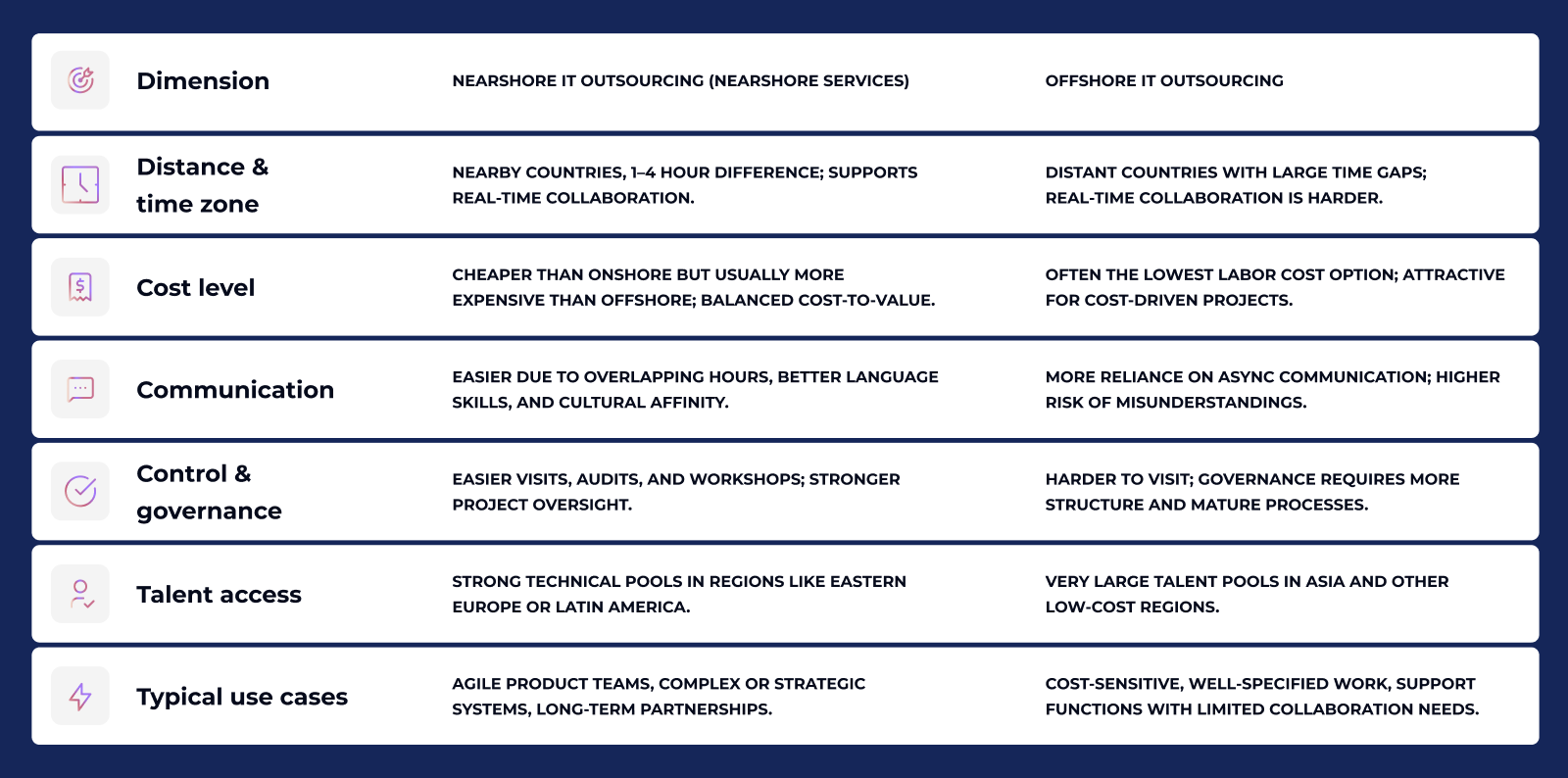
Nearshore IT Outsourcing

For growing businesses that value speed, innovation, and close collaboration, nearshore outsourcing often delivers better long‑term outcomes despite slightly higher day‑rate costs. Offshore models remain attractive when cost is the main driver and work is well‑defined and less dependent on real‑time communication.

Key Nearshore Software Development Services

Most providers offer a broad portfolio of nearshore software development services designed to support both product and enterprise IT roadmaps. These services can span full lifecycle development or target specific functions where external expertise is most valuable.

Typical engagement models range from dedicated teams and staff augmentation to fixed‑scope projects and managed services, depending on a company’s maturity and governance preferences. Many partners also provide consulting around architecture, DevOps, security, and agile delivery.

Software Development

Nearshore software development covers end‑to‑end design, build, and maintenance of applications, platforms, and digital products. Teams commonly work with modern stacks, cloud‑native patterns, and agile frameworks such as Scrum or Kanban.

Providers can help with greenfield product builds, legacy modernization, API development, integration, and mobile or web front‑ends. For growing businesses, a nearshore development team often functions as an extension of the in‑house product or engineering organization.

IT Service Management

Many nearshore IT vendors offer managed IT service management (ITSM), including monitoring, incident and problem management, and service desk operations. When aligned to frameworks such as ITIL, these services help maintain stability while internal teams focus on transformation and innovation.

Because of time zone overlap, nearshore ITSM teams can support business‑critical hours, with options to extend coverage to 24/7 via blended models. This balance ensures reliable operations without building large internal support centers.

Cloud Services

Nearshore partners frequently provide cloud services such as migration, infrastructure automation, FinOps, and platform engineering. They often combine certified cloud expertise with DevOps practices to help organizations modernize and scale efficiently.

These teams can build and operate environments on major cloud platforms, implement CI/CD pipelines, and support containerization and microservices architectures. For growing businesses, this accelerates cloud adoption while controlling risk and spend.

Quality Assurance and Testing

Quality assurance and testing are common components of nearshore software development services, often integrated directly into agile teams. Providers support functional testing, test automation, performance testing, and security testing throughout the lifecycle.

Nearshore locations with strong technical education systems supply experienced QA engineers who can implement robust test strategies and modern tooling. Time zone alignment allows testers and developers to collaborate closely, reducing defect leakage and improving release reliability.

Risks and Challenges of Nearshore Outsourcing

Nearshore IT outsourcing reduces some risks associated with distant offshoring, but it is not risk‑free. Businesses still need to manage operational, cultural, legal, and security considerations carefully to protect outcomes.

Common challenges include misaligned expectations, inconsistent communication practices, varying engineering standards, and compliance issues around data and intellectual property. Addressing these proactively through governance and partner selection is essential for sustainable success.

Communication Barriers

Even with closer proximity, communication issues can arise due to language nuances, differing working styles, or inconsistent documentation practices. As teams scale, information can become fragmented if channels, tools, and rituals are not standardized.

Without clear ownership of product management and requirements, nearshore teams may implement features that do not fully match business expectations. This risk is magnified when stakeholders assume proximity automatically guarantees alignment, rather than investing in structured communication.

Cultural Differences

While cultural distance is usually smaller in nearshore than offshore arrangements, differences in work culture, decision‑making, and hierarchy can still affect collaboration. Some regions may be more indirect in raising issues or more formal in communication, which can influence feedback loops.

If leaders do not invest in building shared culture, norms, and ways of working, misunderstandings can slow projects or impact morale. Cross‑cultural training and conscious team‑building activities help mitigate these risks.

Intellectual Property Concerns

Outsourcing any IT or software development function introduces questions around intellectual property (IP), data protection, and regulatory compliance. While many nearshore locations operate under strong legal frameworks, companies must still ensure that contracts and processes adequately safeguard IP.

Key concerns include code ownership, reuse of components, handling of confidential data, and compliance with frameworks like GDPR or industry‑specific regulations. Robust NDAs, clear IP clauses, and secure development practices are critical to reducing legal and reputational risk.

Best Practices for Successful Nearshore Partnerships

Successful nearshore IT outsourcing depends as much on governance and collaboration as on cost and technical skills. Growing businesses that invest in relationship management and shared delivery models tend to achieve better outcomes and longer‑term value.

Core best practices include rigorous partner selection, clear contracts, integrated teams, disciplined communication routines, and outcome‑focused metrics. Treating providers as strategic partners rather than transactional vendors also encourages innovation and continuous improvement.

Selecting the Right Nearshore Development Team

Choosing the right nearshore development team starts with defining strategic objectives, required skills, and preferred engagement models. Companies should evaluate potential partners on technical capability, domain knowledge, security posture, and cultural fit.

Site visits, reference checks, and pilot projects can validate whether a provider’s delivery practices and communication style match expectations. For critical systems, it is wise to favor partners with a proven track record in similar industries or technologies.

Establishing Clear Communication Channels

Clear, consistent communication is essential for nearshore IT outsourcing to deliver its potential benefits. Teams should agree on collaboration tools, meeting cadences, escalation paths, and documentation standards from the outset.

Many organizations adopt agile ceremonies—daily stand‑ups, sprint reviews, retrospectives—as the backbone of interaction between in‑house and nearshore teams. Assigning product owners and delivery managers with explicit responsibility for coordination further strengthens alignment.

Defining Scope and Expectations

Even in agile environments, success depends on shared understanding of scope, priorities, and quality thresholds. Businesses should provide clear product roadmaps, acceptance criteria, and definitions of done for nearshore teams.

Contracts and statements of work should articulate responsibilities, service levels, security requirements, and governance processes. This structure allows flexibility at the sprint level while keeping broader business outcomes on track.

Monitoring Performance Metrics

Measuring performance with agreed‑upon metrics helps maintain transparency and trust in nearshore engagements. Common indicators include deployment frequency, lead time, defect rates, service availability, and customer satisfaction scores.

Regular reviews using these metrics enable both parties to identify bottlenecks, improve processes, and adjust team composition or scope as needed. Over time, this data‑driven approach turns the nearshore partnership into a continuous improvement engine.

Red also: Nearshore IT Outsourcing Pricing Models: ALL you need to know

Future Trends in Nearshore IT Outsourcing

Nearshore IT is evolving quickly as digital transformation, remote work, and AI reshape how organizations build and operate technology. Regions that invest in digital skills, connectivity, and regulatory alignment are positioned to capture growing demand.

For growing businesses, these trends mean more sophisticated service offerings, richer ecosystems of providers, and more competition for the best partners. Staying informed about market shifts can help organizations choose locations and engagement models that remain resilient over time.

Remote Work Models

The rise of distributed work has made it normal for teams to collaborate across borders and time zones, accelerating adoption of nearshore IT models. Modern remote work practices—digital workspaces, asynchronous documentation, and video‑first collaboration—fit naturally with nearshore arrangements.

Businesses increasingly design hybrid setups where internal staff, nearshore teams, and sometimes offshore teams operate as a single virtual organization. This structure allows flexible scaling while preserving strong product ownership and architecture control internally.

Integration of AI and Automation

AI and automation are becoming integral to nearshore software development and IT service management. Providers are incorporating AI‑assisted coding, intelligent test automation, and observability tools to increase productivity and quality.

Nearshore partners that invest in these capabilities can help clients modernize faster, optimize operations, and experiment with new digital products and services. For growing businesses, selecting vendors with strong AI and automation expertise will become an increasingly important differentiator.

Conclusion

Nearshore IT outsourcing offers growing businesses a balanced model that combines cost efficiency, access to diverse talent, and high‑quality collaboration through time‑zone and cultural alignment. When organizations select capable partners, establish clear governance, and invest in integrated ways of working, nearshoring becomes a strategic enabler of faster, more reliable digital delivery.

As remote work, AI, and global competition continue to reshape technology organizations, nearshore services and nearshore software development teams will play an expanding role in modern IT strategies. Companies that understand the benefits, risks, and best practices today will be better positioned to leverage nearshore IT for sustainable growth in the years ahead.

Go to

Lates Articles